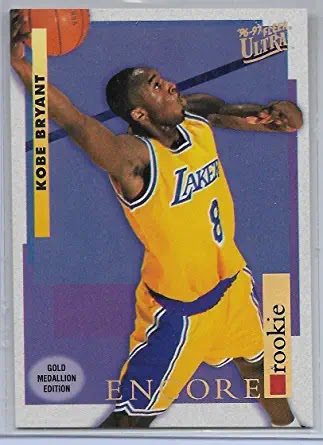
Childhood's End


I've been watching NBA basketball for literally my entire life. Some of my earliest memories directly centre on it--staying up late on school-nights to watch west coast games that went into overtime(s); idolizing the '92 Dream Team and putting up decal cut-outs of all of them on my bedroom walls; collecting and trading basketball cards with NBA-obsessed friends; getting jerseys, Starter jackets, and player-endorsed sneakers for birthdays and Christmases; wearing said jerseys, jackets, and sneakers while shooting hoops for countless hours, pretending to be my favourite players.

It truthfully was my first love, and I still love it. My earliest "career goal" was to someday play in the league, though the reality of my limited talents set in soon enough. Nevertheless, some of the happiest (and, admittedly, most painfully disappointing!) moments in my life that did not actually involve me personally or directly were NBA-specific moments, including, most recently, experiencing the Raptors' championship run together with scores of exuberant Canadian basketball fans.

As a lifelong NBA viewer, watching Kobe Bryant was a supreme pleasure. He was just the best of the best: a totally singular combination of otherworldly talent, ferocious tenacity, and indefatigable dedication to his craft. Whether in the Finals or in an otherwise unremarkable regular-season game, he always threatened to do something stunning, something unforgettable, something that even the most constant and attentive of basketball fans had never quite seen before. His 81-point game (against the Raptors) and his 60-point swansong are just two notable examples among so many. He wasn't perfect (on or off the court), but it was his relentless, if quixotic, pursuit of absolute basketball perfection that made him so utterly compelling to watch--a drive brilliantly captured in Spike Lee's Kobe Doin' Work.

I guess I did know on some level that he was only 41, or around that age. It just feels like he's been present in my life for so damned long. Which, come to think of it, makes perfect sense, really--I've grown up alongside him, watching him enter the league as a teenager, straight out of high school, then rapidly ascend to dominate for most of two decades. That elusive sixth ring notwithstanding, his basketball career felt extraordinarily complete. His life after the NBA, so tragically, was not--and that tragedy is multiplied exponentially by the deaths of his young daughter and others. It's surreal, and it's awful.
2010s: 100 Movies + 50 Albums

Decade favourites here.
2019: Traumas past and present (and future)


FILMS
01. A Hidden Life (Malick)
02. The Irishman (Scorsese)
03. Lost Course (Li)
04. Dwelling in the Fuchun Mountains (Gu)
05. Portrait of a Lady on Fire (Sciamma)
06. High Life (Denis)
07. Ad Astra (Gray)
08. Mary Magdalene (Davis)
09. MS Slavic 7 (Bohdanowicz/Campbell)
10. The Body Remembers When the World Broke Open (Tailfeathers/Hepburn)
11. Atlantics (Diop)
12. Jojo Rabbit (Waititi)
13. The Lodge (Franz/Fiala)
14. Midsommar (Aster)
15. Oh Mercy! (Desplechin)
16. 1917 (Mendes)
17. One Day in the Life of Noah Piugattuk (Kunuk)
18. Once upon a Time in Hollywood (Tarantino)
19. Uncut Gems (Safdie/Safdie)
20. Young Ahmed (Dardenne/Dardenne)
21. The Lighthouse (Eggers)
22. Parasite (Bong)
23. Toy Story 4 (Cooley)
24. Little Women (Gerwig)
25. US (Peele)
26. Koko-di Koko-da (Nyholm)
27. The Twentieth Century (Rankin)
28. High-Flying Bird (Soderbergh)
29. The Farewell (Wang)
30. The Two Popes (Meirelles)

PERFORMANCES
01. Jonathan Pryce and Anthony Hopkins, The Two Popes
02. Joaquin Phoenix and Rooney Mara, Mary Magdalene
03. Willem Dafoe and Robert Pattinson, The Lighthouse
04. Joe Pesci, Al Pacino, and Robert De Niro, The Irishman
05. Brad Pitt, Leonardo DiCaprio, and Margot Robbie, Once upon a Time in Hollywood
06. Adam Sandler, Uncut Gems
07. Juliette Binoche, High Life
08. Lupita Nyong'o, US
09. Riley Keough, The Lodge
10. Deragh Campbell, Anne at 13,000 Feet
11. Florence Pugh, Little Women
12. Adèle Haenel and Noémie Merlant, Portrait of a Lady on Fire
13. Awkwafina and Zhao Shuzhen, The Farewell
14. Roschdy Zem, Sarah Forestier, and Léa Seydoux, Oh Mercy!
15. The entire cast of Parasite

ALBUMS
01. FKA twigs, Magdalene
02. Billie Eilish, When We All Fall Asleep, Where Do We Go?
03. Ariana Grande, Thank U, Next
04. Carly Rae Jepsen, Dedicated
05. Mount Eerie and Julie Doiron, Lost Wisdom pt. 2
06. Taylor Swift, Lover
07. Solange, When I Get Home
08. Kanye West, Jesus Is King
09. Lizzo, Cuz I Love You
10. Sleater-Kinney, The Center Won't Hold

Listen to Your Heart

One of the all-time great power ballads. RIP.
In Storms of Steel


Sam Mendes's 1917 may very well be the most intensely realistic war movie ever made, a hypnotic hybrid of immersive VR and the grim matter-of-fact-ness of Ernst Jünger's war prose, or else like the famous opening sequence of Saving Private Ryan extended to two full hours and transported from the beaches of WWII Normandy to the rat-infested trenches and no man's land of the First World War. It's appropriately exhausting, in the expected, rigorous war-epic way but also uncommonly demanding on the viewer's eyes; the sustained illusion of a single, largely mobile shot, masterfully executed by Roger Deakins, provides little opportunity to blink or relax. Few movies more palpably express the feeling that there could be fatal danger anywhere and everywhere. As in Jünger's memoir, staying alive is a matter of constant luck and split-second decision-making.

With its genuinely nightmarish atmosphere and pervasive sense of dread and terror, 1917 is also (more so than most war films) a great horror movie, though, like many great horror movies, it relies too heavily on its musical score to build tension and foreshadow. In this otherwise ultra-realistic film, such artifice feels especially superfluous, undermining the immediacy of the action. It is also, just occasionally, too sentimental, attempting to win the audience's sympathy through calculated bits of character exposition –– another common horror-movie misstep. Yet, the best sequences in Mendes's film –– particularly one set amidst the hellish ruins of a burnt-out French town –– feel like something new and urgently powerful, summoning up the visceral lived experience of a war that almost no one still living can personally remember.
It's, like, one of the best movies I've ever seen in my life

Kicks Inside


Add to the examples of Mary Magdalene's enduring, modern pop-cultural clout the best album of 2019. Every time I listen to it (must be 50x-plus at this point), I hear new, strange and interesting things. I also, by turns, hear flashes of Björk, Kate Bush, Polly Jean Harvey, Tori Amos, Tricky, and EMA; Teresa, in cluing me into how fucking great this record is, suggested Kanye and Portishead, which I can sometimes hear, too. And yet, taken as a cohesive whole, played front to back (as it really should be, to an extent that few albums these days necessitate), it's finally, thrillingly sui generis––somehow huge and dramatic and, at the same time, hyperintimate, moving and tender and weird and wonderful. A gift that keeps on giving. She does it like Mary Magdalene.
Unknown Pleasures


Upon reflection, this might be my favourite movie moment of the past decade.
Last Rites


I hope Martin Scorsese lives to be 120 and makes two dozen more movies, like an American Manoel de Oliveira, confounding critics who keep approaching each new film as a de facto swansong. But if, by sad chance, Silence and The Irishman turn out to be his last two narrative features, they would arguably stand as the most stunning, and apt, one-two punch to conclude any great oeuvre. The former is, in my view, his best film; the latter is very close. Both are overwhelmingly powerful products of a true master working not only in the autumn of his career but at the peak of his talents. Silence feels like a summation of the aching, ambivalent spirituality that pervades so much of Scorsese's filmography, building and improving upon earlier works like The Last Temptation of Christ and Kundun. The Irishman is a meditation on the criminal culture surveyed in GoodFellas and Casino, and more broadly on the changing sociopolitical landscape of twentieth-century America.

But if GoodFellas was Stagecoach, The Irishman is Scorsese's The Searchers, or maybe Cheyenne Autumn. (Movie analogies seem like a particularly appropriate way of assessing the work of this most intensely cinephillic of filmmakers.) It's about the end of things: careers, lives, a century, a culture. Like Silence, it's a film of serious and uncomfortable questioning, of wondering whether any of it was worth it –– worth the effort, the journey, the sacrifices, the sin. These are not simply "greatest hits" films, although they do summarize much of what Scorsese does best; they are retractationes, mature reconsiderations of a life's work. More than any film since Scorsese's first masterpiece, Mean Streets, The Irishman merges together nearly all of his major themes and concerns. To be sure, he made some movies before Mean Streets and hopefully he'll make many more after The Irishman (he just turned 77; perhaps he should run for president?), but these may still be rightly read as the bookends of a singular, vital corpus.
Fuck school shooters.
Fuck guns.
Fuck gun manufacturers, who literally profit from death and the sociopathic urge to kill other living beings.
Fuck the idiotic, anachronistic 2nd Amendment.
Fuck the piece-of-shit, cowardly politicians who hide behind it as an excuse to never change anything.
Fuck the cartoonishly evil NRA.
Fuck the cartoonishly evil, cult-of-personality GOP.
Fuck the excuse that people need guns because they like to murder animals for fun.
Hidden Lives


Jojo Rabbit is so much better than I expected it to be. I mostly went to see it because it looked more or less kid-friendly and didn't involve superheroes or low-quality digital animation. The premise, though, sounded like it could make for a Life Is Beautiful–level disaster of appallingly misplaced comedy. It's not that. The comedy actually works, not only as a way of highlighting the deep absurdity of the Third Reich and its ideology, but also as one way of explaining how its methods of mass brainwashing functioned, particularly for an impressionable, naive kid whose personal conception of the Führer bore only a vague, superficial resemblance to reality. This is a genuinely great coming-of-age movie and, at the same time, a fairy tale about how sudden familiarity with the vilified Other is (sometimes) all it takes to break the spell of cultural indoctrination––a universal parable that speaks powerfully to present circumstances. Although Taika Waititi conceived of this project almost a decade ago, presumably without the aid of a crystal ball, it's especially resonant right now, with far-right, semi-fascist, and white supremacist forces having crept squarely into the mainstream of Western politics.

As a truly incisive satire, Jojo Rabbit isn't nearly as effective as, say, The Death of Stalin, mainly because it's too warm and humane. Some critics have derided the film's ultimate "conventionality," implying that it's a kind of dirty secret concealed (though not well enough) by Waititi's more radical, anarchic flourishes. But I think there's something to be said for this straightforward, poignant storytelling, even if takes some of the edge off the satire. The last scene is as classically lovely, and touching, as anything in recent cinema, even calling to mind Chaplin–––specifically, the final moments of City Lights, not The Great Dictator. Above all, Waititi's movie is a modest ode to those who summon up the courage to resist evil, those who, as the film's characters put it, did "what they could." This is not a particularly original theme, but it's a perennially important one, which it shares with the year's best film, Malick's A Hidden Life. Both are unapologetically sentimental histories; and both, under layers of artistic license and distinctively aestheticized representation, are essentially built from the stuff of "conventional" storytelling. They would make for a bizarre, yet potentially fruitful, double bill.
But tonight you presume too much


(Not my video, but I was there.)

Terrific show on the whole, though not necessarily the greatest setlist.

Highlights:
1. "Jack the Ripper" (one of his very best songs, stunningly performed)
2. "Why Don't You Find Out for Yourself"
3. "Is It Really So Strange?"
4. "Suedehead"
5. "Seasick, yet Still Docked"
6. "Everyday Is Like Sunday"
7. "I Wish You Lonely"
8. The fact that he didn't talk politics at all (a great relief!)
9. His story about how, when he retires from music, he wants to move to Ropongi Hills, Tokyo; the only trouble with this is that I'd really like to hear His Tokyo Record!

Gripes:
1. Too little Smiths (just the 1 song! by comparison, Marr played 6 at his show here last year)
2. Too little Vauxhall and I, or, as he referred to it last night, "Vancouver and I" (still by far his best post-Smiths album; at least "Why Don't You Find Out for Yourself" sounded really great)
3. Too much California Son (just meh af)
4. "World Peace Is None of Your Business" (Is Not a Good Song, and Also Suggests Some of His Worst Tendencies/Ideas)
VIFF: Best of the Fest


(It was an exceptionally good year, so I've cheated a little here.)

FILMS
01. A Hidden Life (Malick)
02. Lost Course (Li)
03. Dwelling in the Fuchun Mountains (Gu)
04. Portrait of a Lady on Fire (Sciamma)
05. MS Slavic 7 (Bohdanowicz/Campbell)
06. The Lodge (Franz/Fiala)
07. Oh Mercy! (Desplechin)
08. One Day in the Life of Noah Piugattuk (Kunuk)
09. Young Ahmed (Dardenne/Dardenne)
10. The Lighthouse (Eggers), Parasite (Bong), and The Twentieth Century (Rankin) [tie]

PERFORMANCES
01. Jonathan Pryce and Anthony Hopkins, The Two Popes
02. Willem Dafoe and Robert Pattinson, The Lighthouse
03. Riley Keough, The Lodge
04. Deragh Campbell, Anne at 13,000 Feet
05. Adèle Haenel and Noémie Merlant, Portrait of a Lady on Fire
06. Roschdy Zem, Sarah Forestier, and Léa Seydoux, Oh Mercy!
07. The entire cast of Parasite
08. Valerie Pachner, A Hidden Life
09. Anthony Wong, Still Human
10. Lise Leplat Prudhomme, Joan of Arc
VIFF, pt. 4: One More


The Lodge In (another) strong year for interesting horror movies, Veronika Franz and Severin Fiala's English-language follow-up to Goodnight Mommy –- exploring much the same thematic territory –- is the best of the bunch. I'm usually not especially careful when it comes to "spoilers," but in this case, the less revealed in advance of seeing it, the better (don't watch the trailer!). Suffice it to say that Franz and Fiala's film is unrelentingly tense and unnerving, pervaded by a thick atmosphere of dread. Few horror movies in recent memory use sound (or near-silence) so effectively: the soundtrack is mostly dominated by the sound of wind sweeping over snow; when this ominous calm is suddenly interrupted –– by a church organ, or the sound of ice cracking, or a gunshot –– it provides a serious jolt. Yet, such shocks aside, this is, for the most part, not a jump-scare sort of horror movie, but one that digs deeper under the surface, gradually winding through its characters' (and audience's) psyches to disorienting and genuinely disturbing effect. Comparisons to Hereditary are inevitable –– the fractured family themes, the prominent, creepy use of dolls, etc. –– but The Lodge is more subtle and slow-building than Ari Aster's film; and the performance at its core, Riley Keough's eerily understated turn, is in some ways the opposite of the volcanic intensity of Toni Collette's. Both films, in any case, rank as instant classics of their genre, "prestige" or not.
VIFF, pt. 3: Duos habet!


The Two Popes When Jonathan Pryce and Anthony Hopkins are on screen together, this is a great movie. It really feels like we're watching the actual Popes Francis and Benedict XVI interacting, feeling each other out, quarrelling over issues of Church leadership and doctrine, learning to appreciate the other's virtues, despite their considerable differences in style, worldview, and ecclesiology (the papal names they've selected are deeply telling in this regard). These are two of the most fully realized portrayals of real, famous people –– familiar to us, but always at a remove –– that I can recall. When the leads are not sharing the screen, Fernando Meirelles's film is a very mixed bag: The opening act, from the death of John Paul II to Benedict mulling over his decision to abdicate, feels rushed, like a Cliff Notes summary of recent history; as a snapshot of intra-Vatican politics and factionalism, this is far less convincing than, say, The Young Pope (notwithstanding Paolo Sorrentino's series being a work of fiction). The lengthy flashbacks, providing exposition for the complicated pre-papal career of Francis (then Jorge Mario Bergoglio), are awkwardly inserted and shot (inexplicably, some are in black and white, while others are in colour). They tend to play like cheaply produced dramatic re-enactments in a true-crime show, the quality of which contrast sharply with the incredible performances of Pryce and Hopkins. While the past events depicted do help us better understand Francis and his reluctance to accept the papal crown, they could've been more effectively incorporated simply through more conversation between Pryce and Hopkins. Perhaps most problematically, one is never quite sure if The Two Popes is intended as a critique of the papal office and/or of the Church generally, or as a sort of love letter to these powerful institutions. The magnetic charisma of the leads, "humanizing" not just the well-loved Francis but also the more opaque Benedict, suggests the latter, even as Meirelles works in repeated references to the Church's chronic failure to address its legacy (and on-going crisis) of mass child abuse and its long history of tacitly supporting (or at least neglecting to oppose) murderous and oppressive regimes.

Portrait of a Lady on Fire Céline Sciamma's follow-up to the terrific Girlhood also centres on two people who get to know one another under highly particular and unusual circumstances (although that's probably where its similarities with The Two Popes end). Set in eighteenth-century France, Sciamma's drama is historically specific with regard to the extent of the constraints placed on female agency and its excellent, if austere, period detail, but it also has a timeless, fairy-tale-like atmosphere that feels indebted to Jane Campion (especially The Piano, less so Campion's adaptation of Henry James's Portrait of a Lady) and to Perrault's tales. Some synopses of Sciamma's film place it in the 1770s, while others see it taking place "at the end of the eighteenth century." I'm assuming that the main story is set just before the events leading up to the French Revolution, yet, unless there was some explicit date marker that I failed to spot, this is not at all certain. Such ambiguity –– keeping such a world-historical event totally outside the narrative frame –– speaks to the laser-focused intimacy and thoroughly feminine orientation of Sciamma's film. More than a usual "period drama," it feels like a dream of the past, a subversive romantic fantasy doomed to muted tragedy by its time and place. Its power sneaks up on you, building to a final shot that is among the most indelibe in recent memory.

Oh Mercy! Arnaud Desplechin's latest is an abrupt change of direction in the course of his career, almost completely eschewing the layers of artifice and meta conceits so characteristic of his oeuvre. Instead, Oh Mercy!, adapted from police transcripts and a TV investigative documentary about Desplechin's rough, northern French hometown of Roubaix (the film's much-superior French title is Roubaix, une lumière), is a realistic police procedural and gritty mosaic of contemporary life in this city. It's tightly scripted and superbly acted, with stand-out performances by Roschdy Zem, Sarah Forestier, and Léa Seydoux. One can imagine this translating well, and pretty easily, to the stage, particularly a remarkable long scene near the end that is all about performance, staging, and direction. Yet, at the same time, Oh Mercy! is still quite distinctly cinematic. Desplechin captures the urban environs of Roubaix with both affection and uneasiness--there is beauty, but also real danger, here––lending the film a strong touch of noir style, evident too in its rumantive, pessimistic voice-over narration. In the post-screening Q&A, Desplechin cited Hitchcock (The Wrong Man) and Bresson (Diary of a Country Priest) as influences for this project. When a member of the audience asked whether he conducted interviews with the real Roubaisians represented in the film, he answered firmly in the negative. Instead, for "research," he re-read Dostoevsky's Crime and Punishment in multiple translations.

One Day in the Life of Noah Piugattuk Zacharias Kunuk's best film since Atanarjuat: The Fast Runner re-creates the 1961 encounter of the titular Inuit community leader with a Canadian government officer on Baffin Island. The white officer tries to convince Piugattuk to move his family from their ancestral home to a government settlement, and to send his children to school there. In return, he'll receive a wooden house, heated by a stove, a monthly family allowance payment, and access to desired commodities like tea, sugar, and tobacco. A local guide imperfectly translates the communication between Piugattuk and other Inuits and this government representative––a tense meeting that takes up the majority of Kunuk's film. What these scenes illustrate is the process of forced assimilation at work, in medias res. It only hints at the coercion and cultural destruction involved in this process, while suggesting that a profound lack of understanding was also partly to blame for it: first, at the level of language, though more generally of mutually incomprehensible mentalities and ideas about "home," identity, money, and productivity/utility. The flawed translation between English and Inuktitut feels wholly authentic, showing in vivid detail how such a meeting might well have played out. It also serves as a kind of microcosm for the ultimate failure in real communication that occurred between Inuit and other indigenous peoples across North America and the representatives of colonial governments. Yet, as in all of Kunuk's films, the situation is necessarily specific to Nunavut, the beautiful and severe Arctic landscape, and the Inuit culture. This film, after all, is set in 1961, by which time nearly every other corner of the continent had long since been enveloped by the "governmentality" of the Canadian or American state. Language gap notwithstanding, Noah Piugattuk clearly expresses his anxiety about the Canadian officer's proposal/command, though he refuses to directly state his choice. Despite his indecision, Kunuk frames this fateful encounter as a truly decisive moment in the modern history of the Inuit people and the (culturally and spatially) distant state imposing its will on them.

The Twentieth Century Matthew Rankin's bizarro biopic of Canadian Prime Minister William Lyon Mackenzie King is a weird, sporadically hilarious delight, like a cross between fellow Winnipegger Guy Maddin (especially his Saddest Music in the World) and rightful cult classic Cabin Boy. To be sure, King was almost certainly Canada's strangest PM. For instance: "Not only did King speak with his dead mother, but he communicated with the ghosts of such famous figures as the former prime minister Sir Wilfred Laurier, and even Leonardo da Vinci. He used a crystal ball, now found at Laurier House." And: "King saw magical images in his tea leaves, and even more oddly, in his morning cup of shaving cream. On January 20, 1948, he visualized in his morning lather symbols of the Cold War, a polar bear and an eagle...Then a dog appeared, perhaps symbolizing Canada, which helped push the bear off the eagle." Even so, Rankin pushes his story into still odder, more aggressively surreal territory, skewering not just King and his era of staunchly elitist Canadian politics, but clichéd ideas about Canada, its history and traditions that survive up to the present, often generally accepted and unquestioned. The film gets a little tedious as it nears the home stretch, but on the whole, it's a lot of fun; I'll certainly never look at a Canadian $50 bill the same way again!

Edo Avant Garde As in Leonardo: The Works, the main pleasure in Linda Hoaglund’s documentary is "the works" themselves, in this case Japanese folding screens produced between the early seventeenth and mid nineteenth centuries, filmed in awesome, gracefully mobile HD by cinematographer Kasamatsu Norimichi. These extraordinary works, decidedly more unfamiliar to most Western audiences than Leonardo's masterpieces, are fascinating to look at (the more closely and patiently the better); and, as the films shows, they take up space and invite visual engagement in a way that is quite different from typical Western oil paintings. It's an important point, too, that something is inevitably lost from this experience by viewing these screens displayed behind glass in a museum or gallery. Hoaglund aims to place them back in their proper contexts, both by showing folding screens arranged in traditional rooms that could've been occupied by (sitting) Edo-era aristocrats or monks and by providing some useful historical information about the wider world of Edo Japan, particularly the shift in patronage to a wealthy merchant class, facilitated by Japan's rapid urbanization, and the combined influences of Buddhism and Shintoism on the art of this period. However, Hoaglund's primary argument--that in their non-naturalistic, "3D" perspective; lack of a clear centre or vanishing point; use of materials like goldleaf to form background space; and focus on animals, plants, and other elements of the natural world without direct reference to human beings, these folding screens were "avant-garde" art, conceptually and stylistically ahead of European painting in this period--is, ironically, too narrowly West-centric, tied to a flimsy History of Art master-narrative that few art historians today would accept and to an overly rigid East/West binary. Hoaglund compares the Edo screens to European art between the Italian Renaissance and the French Impressionists, noting that Van Gogh was heavily influenced by Japanese styles. But what if we broadened the scope to compare these works to Islamic or Persian art (flowing floral schemes and patterns), Byzantine art (particularly the use of goldleaf backgrounds), or even medieval European art (similarly de-centered works like tapestries, which invite a comparable type of nonlinear engagement), rather than only to Old Master paintings? In so doing, we might find that, while the art of Edo Japan was no doubt unique and spectacular, it was rather 400 years of European painting (ca. 1400–1800) that stand as the true outlier in the longer, global history of visual art.