One To Get Started, Three 'Til We Go
Sometimes YouTube's "Recommended" panel yields gold: Couldn't resist posting this clip, as it combines two of my favorite things in the whole wide world.

4 Records, 2 Blurbs
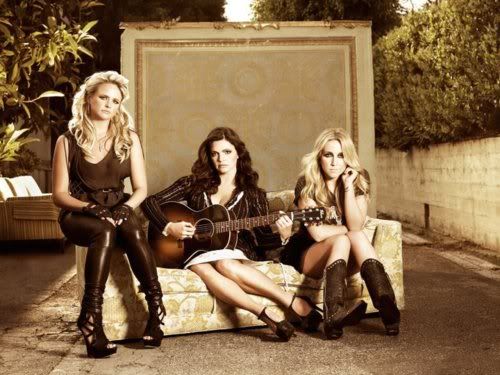
Lazy or economical? You decide.
Pistol Annies, Hell on Heels > Miranda Lambert, Four the Record: I would despair that Miranda's fourth album is her least inspired, but a) the downturn from Revolution to Four the Record isn't nearly as steep as from the near-perfect Crazy Ex-Girlfriend to the only-fine Revolution; and b) there's Pistol Annies! Hell on Heels, Lambert's side-group debut with Ashley Monroe and Angaleena Presley, is spontaneous and quirky where Four the Record feels strained, it's a quick jolt of country-pop pleasure where Miranda's latest solo outing plods in places (especially toward the end). If, as Christgau suggests, the Pistol Annies are now Miranda's outlet for her hell-raiser "Kerosene"/"Gunpowder and Lead" side with the big Nashville ballads (e.g., "The House That Built Me") the default raison d'être of her solo albums, where does that leave the less neatly categorizable, middle-way (but not MOR) material that made up about half of Crazy Ex-Girlfriend (think: "Desperation," "Guilty in Here," "Famous in a Small Town"). Miranda, at her best, has more than two sides; I just hope her new work set-up doesn't change that.
Sorry 4 the Wait > Tha Carter IV I like Tha Carter IV more than a lot of Lil Wayne fans do, and I've totally come around "How to Love," which at first I didn't care for; the part where Wayne sings, "You seen a lot of crooks and them crooks still crooks," such a basic line on paper, tickles the ear in such an unexpected way. And it's actually poignant, too. But the formula that dictates that Wayne's mixtapes will always be better showcases for his specific genius than his studio albums are holds true post-prison. There's a sense on his best mixtapes--Da Draught 3, Tha Carter III mixtape, and now Sorry 4 the Wait--that virtually anything could happen at any moment; see, for example, the title track on this new one, where Wayne raps over "Rolling in the Deep." That delirious sense of possibility is what's mostly absent from his studio albums, even when they're very good (Tha Carter's II and IV) or great (III).
Lazy or economical? You decide.
Pistol Annies, Hell on Heels > Miranda Lambert, Four the Record: I would despair that Miranda's fourth album is her least inspired, but a) the downturn from Revolution to Four the Record isn't nearly as steep as from the near-perfect Crazy Ex-Girlfriend to the only-fine Revolution; and b) there's Pistol Annies! Hell on Heels, Lambert's side-group debut with Ashley Monroe and Angaleena Presley, is spontaneous and quirky where Four the Record feels strained, it's a quick jolt of country-pop pleasure where Miranda's latest solo outing plods in places (especially toward the end). If, as Christgau suggests, the Pistol Annies are now Miranda's outlet for her hell-raiser "Kerosene"/"Gunpowder and Lead" side with the big Nashville ballads (e.g., "The House That Built Me") the default raison d'être of her solo albums, where does that leave the less neatly categorizable, middle-way (but not MOR) material that made up about half of Crazy Ex-Girlfriend (think: "Desperation," "Guilty in Here," "Famous in a Small Town"). Miranda, at her best, has more than two sides; I just hope her new work set-up doesn't change that.
Sorry 4 the Wait > Tha Carter IV I like Tha Carter IV more than a lot of Lil Wayne fans do, and I've totally come around "How to Love," which at first I didn't care for; the part where Wayne sings, "You seen a lot of crooks and them crooks still crooks," such a basic line on paper, tickles the ear in such an unexpected way. And it's actually poignant, too. But the formula that dictates that Wayne's mixtapes will always be better showcases for his specific genius than his studio albums are holds true post-prison. There's a sense on his best mixtapes--Da Draught 3, Tha Carter III mixtape, and now Sorry 4 the Wait--that virtually anything could happen at any moment; see, for example, the title track on this new one, where Wayne raps over "Rolling in the Deep." That delirious sense of possibility is what's mostly absent from his studio albums, even when they're very good (Tha Carter's II and IV) or great (III).

Single of the Year

But not the first time you hear it. You're just like, "Right, they're back. Sweet." And then the second or third or fourth time it starts to do things. (Like convince you for three and a half minutes that it's July and not November. Or that videos of normal people dancing are coolly DIY.)
It came as a surprise to me, too.
Nearing the home-stretch, I thought it had to be Adele. Why? Because even the Linkin Park version is good and everybody sings along. (Plus the CBC Stanley Cup finals clip [but that didn't work out so well...])
Or maybe it should be "E.T." because of the stuttered consonants on the chorus--and as much for the "pockets on Shrek/rockets on deck" bit as in spite of it.
Or even "I Just Had Sex" for perfectly capturing, and encapsulating, a specific feeling when Akon sings "and my dreams came true," then blasts off into the stratosphere. (Perhaps to join Alien Katy Perry?)
All fine candidates, but no; when Lovefoxxx drops
We have too many bruises, from too much kissing
And the only pain would be from too much missing
it's game over.
But not the first time you hear it. You're just like, "Right, they're back. Sweet." And then the second or third or fourth time it starts to do things. (Like convince you for three and a half minutes that it's July and not November. Or that videos of normal people dancing are coolly DIY.)
It came as a surprise to me, too.
Nearing the home-stretch, I thought it had to be Adele. Why? Because even the Linkin Park version is good and everybody sings along. (Plus the CBC Stanley Cup finals clip [but that didn't work out so well...])
Or maybe it should be "E.T." because of the stuttered consonants on the chorus--and as much for the "pockets on Shrek/rockets on deck" bit as in spite of it.
Or even "I Just Had Sex" for perfectly capturing, and encapsulating, a specific feeling when Akon sings "and my dreams came true," then blasts off into the stratosphere. (Perhaps to join Alien Katy Perry?)
All fine candidates, but no; when Lovefoxxx drops
We have too many bruises, from too much kissing
And the only pain would be from too much missing
it's game over.
Of Gods and Men

Jayson Stark on Albert Pujols' monumental World Series Game 3, in which Pujols became only the third player in baseball history to hit three home runs in a World Series game (following Babe Ruth, who did it twice, and Reggie Jackson).
Robert Christgau's excellent Rock&Roll& piece on Jay-Z and his reconsidered Consumer Guide blurbs for Reasonable Doubt and The Black Album.
Adam Cook on Soderbergh's Contagion, which he terms a "a masterpiece pertinent to current day but guaranteed to become increasingly so as time goes on."
TIME's Richard Stengel and Mark Halperin interview the terrifying Rick Perry.
Jayson Stark on Albert Pujols' monumental World Series Game 3, in which Pujols became only the third player in baseball history to hit three home runs in a World Series game (following Babe Ruth, who did it twice, and Reggie Jackson).
Robert Christgau's excellent Rock&Roll& piece on Jay-Z and his reconsidered Consumer Guide blurbs for Reasonable Doubt and The Black Album.
Adam Cook on Soderbergh's Contagion, which he terms a "a masterpiece pertinent to current day but guaranteed to become increasingly so as time goes on."
TIME's Richard Stengel and Mark Halperin interview the terrifying Rick Perry.
The Limits of Control
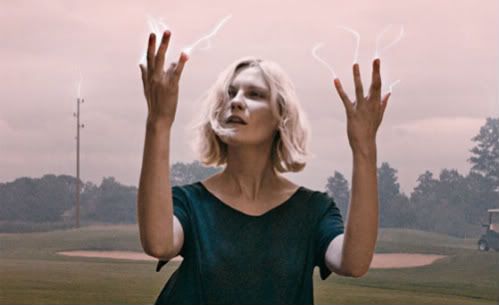
In his Cannes coverage for The A.V. Club, Mike D'Angelo wrote:
Would people even know what to make of Melancholia were it not public knowledge that Von Trier has been suffering from clinical depression for the past few years? (I guess maybe the title might be a wee clue.) More to the point, is it possible to “enjoy” it—whatever that word might mean in this context—if depression is something that you fundamentally don’t understand?
D'Angelo's first point is rather slippery, prompting as it does the question of how many other significant recent films "require" extra-textual information in order to be fully appreciated. Does, for instance, the amazing story of This Is Not a Film being smuggled from Iran to Cannes in a loaf of bread amplify one's admiration for Panahi's accomplishment? Is some knowledge of the autobiographical nature of The Tree of Life necessary to "get" Malick's film? I will return to this point a little later...
As for the second question quoted above, I would contend that this "fundamental" lack of understanding is precisely what von Trier has in mind.
Melancholia is bipartite in its structure, with rhyming halves named for the sisters Justine and Claire. The first half focuses on the clinically depressed Justine (an astonishing return to peak form from Kirsten Dunst), as she navigates the hell that is other people on the night of her wedding reception. For those of us who can't "understand" Justine's (and von Trier's) condition, her turbulent, self-destructive behavior initially seems irrational. Her husband, Michael, (Alexander Skarsgard, light-years from True Blood's Eric) appears to be a nice, well-meaning guy; her wealthy sister, Claire (Charlotte Gainsbourg), and brother-in-law, John (Kiefer Sutherland), are going all out for her reception, hosted at their country mansion/luxury golf resort; her boss, Jack (Stellan Skarsgard), just gave her a raise from copywriter to art director at his advertising form. What's so bad about that?
This, in so many words, is what Claire and John persistently ask Justine, as she moodily retreats from the elaborately orchestrated reception. Justine responds in her own defense that she is trying: smiling, dancing, going through the motions of the just-married. However, even for those of us who can't easily empathize with Justine's emotional state, there are subtle signs that suggest (at least partly) the source of her anxiety: a suffocating lack of control over the decisions that shape her life. When Michael surprises her with a photograph of the land he has secretly signed off on for them to make their home, the sweetness of the gesture, and of his apparent demeanor, obscures the fact that he seemingly hasn't consulted his bride on such a major move. Likewise, Claire and John have meticulously planned out the wedding reception (and, as John repeatedly notes, spent a small fortune on it), leaving Justine little room for input. And in Jack's congratulatory announcement of Justine's promotion, via a toast speech to the newlyweds, there is no question mark regarding Justine's new position--just a forceful exclamation point.
Still, when by the end of the night, Justine's marriage has essentially dissolved, it remains almost incomprehensible (for most of us) how things could have gone so bad so fast--and yet this first-half conclusion feels at least as brutally inevitable as it does baffling. Justine says in parting to Michael that he couldn't have truly expected it to have turned out any other way. He doesn't argue with this point.
The second ("Claire") half of Melancholia mirrors the opening ("Justine") half in this feeling of inexorable doom. For viewers who personally can't understand clinical depression, this section presents an extreme scenario of "situational" depression with which the audience will certainly relate. It is here that the film explicitly morphs into what J. Hoberman calls "Ibsen as science-fiction." A planet, "Melancholia," has gone off its axis (or something) and is headed toward Earth. The scientifically-minded John predicts that it will safely fly by, and Claire tries to buy into his logic--much the same way Justine tries to smile and feign happiness in the film's first half--but never fully accepts his contention, and becomes increasingly hysterical. It soon becomes clear that John is wrong, and that no amount of rationalizing or wishful thinking will prevent what is soon to come.
As much as the rapidly approaching Melancholia itself (and the consequent destruction of Earth), Claire is overwhelmed and terrified by her sudden helplessness. At one point, she tries to get in her car to drive from her country estate into the village, as if being among a larger group of people might somehow stave off disaster. (This scene speaks to the disturbing claustrophobia of the film's second half, wherein the social dynamic of the first half is contrasted by its absence; the audience can only wonder how the rest of the world is responding to, or coping with, this doomsday moment.) Meanwhile, Justine, crashing with Claire and John after her wedding night meltdown, takes a perverse delight in the end of the world; perhaps now all the unsympathetic people who endlessly tell her to just "be happy" will know what it's like to feel the walls violently closing in.
Circling back to D'Angelo's first question: Justine and Claire--and the halves of the film titled for each sister--seem to function as, respectively, the director-surrogate and audience-surrogate. The intense discourse inspired by these concentric relationships gets us somewhere close to the "heart" of the film. So, yes, an understanding of, not the experience of clinical depression (it's like watching a rogue planet travel through the sky en route to obliterating the one we live on, remember?), but of Lars von Trier's much-publicized medical history does add a rich extra layer to one's engagement with Melancholia.
A familiarity with von Trier's filmography doesn't hurt either, as the director is returning critically to key elements of his earlier work. The first half echoes Bess and Jan's wedding in Breaking the Waves, but in the new film the setting is distinctly upper-crust, where in the earlier case it is much more modest (perhaps a reflection on how far von Trier himself has moved beyond his down-and-dirty Dogme 95 days). Also, where Bess is giddily eager to consummate her marriage to Jan, Justine refuses to have sex with Michael--and when she sleeps with another man, it's decidedly not at her husband's desperate insistence. When towards the end of Melancholia, Justine matter-of-factly tells Claire that "life on Earth is evil," it clearly calls to mind Dogville's incendiary final act, but here the context is more existential anxiety than theological, Old Testament wrath. And like Antichrist (also co-starring the terrific Gainsbourg), von Trier's latest is, of course, a deeply personal statement on depression ostensibly packaged as a genre exercise: last time "horror," this time "sci-fi."
But where Antichrist is fatally muddled both in conception and execution, Melancholia is von Trier's most fully-realized film since Dogville. If it requires some contextual leg-work on the part of the viewer, it's worth it; if it's not a masterpiece, it's close.
In his Cannes coverage for The A.V. Club, Mike D'Angelo wrote:
Would people even know what to make of Melancholia were it not public knowledge that Von Trier has been suffering from clinical depression for the past few years? (I guess maybe the title might be a wee clue.) More to the point, is it possible to “enjoy” it—whatever that word might mean in this context—if depression is something that you fundamentally don’t understand?
D'Angelo's first point is rather slippery, prompting as it does the question of how many other significant recent films "require" extra-textual information in order to be fully appreciated. Does, for instance, the amazing story of This Is Not a Film being smuggled from Iran to Cannes in a loaf of bread amplify one's admiration for Panahi's accomplishment? Is some knowledge of the autobiographical nature of The Tree of Life necessary to "get" Malick's film? I will return to this point a little later...
As for the second question quoted above, I would contend that this "fundamental" lack of understanding is precisely what von Trier has in mind.
Melancholia is bipartite in its structure, with rhyming halves named for the sisters Justine and Claire. The first half focuses on the clinically depressed Justine (an astonishing return to peak form from Kirsten Dunst), as she navigates the hell that is other people on the night of her wedding reception. For those of us who can't "understand" Justine's (and von Trier's) condition, her turbulent, self-destructive behavior initially seems irrational. Her husband, Michael, (Alexander Skarsgard, light-years from True Blood's Eric) appears to be a nice, well-meaning guy; her wealthy sister, Claire (Charlotte Gainsbourg), and brother-in-law, John (Kiefer Sutherland), are going all out for her reception, hosted at their country mansion/luxury golf resort; her boss, Jack (Stellan Skarsgard), just gave her a raise from copywriter to art director at his advertising form. What's so bad about that?
This, in so many words, is what Claire and John persistently ask Justine, as she moodily retreats from the elaborately orchestrated reception. Justine responds in her own defense that she is trying: smiling, dancing, going through the motions of the just-married. However, even for those of us who can't easily empathize with Justine's emotional state, there are subtle signs that suggest (at least partly) the source of her anxiety: a suffocating lack of control over the decisions that shape her life. When Michael surprises her with a photograph of the land he has secretly signed off on for them to make their home, the sweetness of the gesture, and of his apparent demeanor, obscures the fact that he seemingly hasn't consulted his bride on such a major move. Likewise, Claire and John have meticulously planned out the wedding reception (and, as John repeatedly notes, spent a small fortune on it), leaving Justine little room for input. And in Jack's congratulatory announcement of Justine's promotion, via a toast speech to the newlyweds, there is no question mark regarding Justine's new position--just a forceful exclamation point.
Still, when by the end of the night, Justine's marriage has essentially dissolved, it remains almost incomprehensible (for most of us) how things could have gone so bad so fast--and yet this first-half conclusion feels at least as brutally inevitable as it does baffling. Justine says in parting to Michael that he couldn't have truly expected it to have turned out any other way. He doesn't argue with this point.
The second ("Claire") half of Melancholia mirrors the opening ("Justine") half in this feeling of inexorable doom. For viewers who personally can't understand clinical depression, this section presents an extreme scenario of "situational" depression with which the audience will certainly relate. It is here that the film explicitly morphs into what J. Hoberman calls "Ibsen as science-fiction." A planet, "Melancholia," has gone off its axis (or something) and is headed toward Earth. The scientifically-minded John predicts that it will safely fly by, and Claire tries to buy into his logic--much the same way Justine tries to smile and feign happiness in the film's first half--but never fully accepts his contention, and becomes increasingly hysterical. It soon becomes clear that John is wrong, and that no amount of rationalizing or wishful thinking will prevent what is soon to come.
As much as the rapidly approaching Melancholia itself (and the consequent destruction of Earth), Claire is overwhelmed and terrified by her sudden helplessness. At one point, she tries to get in her car to drive from her country estate into the village, as if being among a larger group of people might somehow stave off disaster. (This scene speaks to the disturbing claustrophobia of the film's second half, wherein the social dynamic of the first half is contrasted by its absence; the audience can only wonder how the rest of the world is responding to, or coping with, this doomsday moment.) Meanwhile, Justine, crashing with Claire and John after her wedding night meltdown, takes a perverse delight in the end of the world; perhaps now all the unsympathetic people who endlessly tell her to just "be happy" will know what it's like to feel the walls violently closing in.
Circling back to D'Angelo's first question: Justine and Claire--and the halves of the film titled for each sister--seem to function as, respectively, the director-surrogate and audience-surrogate. The intense discourse inspired by these concentric relationships gets us somewhere close to the "heart" of the film. So, yes, an understanding of, not the experience of clinical depression (it's like watching a rogue planet travel through the sky en route to obliterating the one we live on, remember?), but of Lars von Trier's much-publicized medical history does add a rich extra layer to one's engagement with Melancholia.
A familiarity with von Trier's filmography doesn't hurt either, as the director is returning critically to key elements of his earlier work. The first half echoes Bess and Jan's wedding in Breaking the Waves, but in the new film the setting is distinctly upper-crust, where in the earlier case it is much more modest (perhaps a reflection on how far von Trier himself has moved beyond his down-and-dirty Dogme 95 days). Also, where Bess is giddily eager to consummate her marriage to Jan, Justine refuses to have sex with Michael--and when she sleeps with another man, it's decidedly not at her husband's desperate insistence. When towards the end of Melancholia, Justine matter-of-factly tells Claire that "life on Earth is evil," it clearly calls to mind Dogville's incendiary final act, but here the context is more existential anxiety than theological, Old Testament wrath. And like Antichrist (also co-starring the terrific Gainsbourg), von Trier's latest is, of course, a deeply personal statement on depression ostensibly packaged as a genre exercise: last time "horror," this time "sci-fi."
But where Antichrist is fatally muddled both in conception and execution, Melancholia is von Trier's most fully-realized film since Dogville. If it requires some contextual leg-work on the part of the viewer, it's worth it; if it's not a masterpiece, it's close.
VIFF: Best of the Fest
TOP TEN FILMS
01. This Is Not a Film (Panahi/Mirtahmasb)
02. Almayer's Folly (Akerman)
03. The Turin Horse (Tarr)
04. A Separation (Farhadi)
05. A Simple Life (Hui)
06. Year Without a Summer (Tan)
07. Martha Marcy May Marlene (Durkin)
08. Once Upon a Time in Anatolia (Ceylan)
09. Koran By Heart (Barker)
10. The Mill and the Cross (Majewski)
SPECIAL MENTION: Dreileben: Beats Being Dead (Petzold); Immmature (Yang, from A Time to Love); Open Verdict (Ho, from Quattro Hong Kong 2)
FEMALE PERFORMANCE (LEAD)
*Deannie Yip - A Simple Life
MALE PERFORMANCE (LEAD)
*Jafar Panahi - This Is Not a Film
FEMALE PERFORMANCE (SUPPORTING)
*Luna Zimic Mijovic - Dreileben
MALE PERFORMANCE (SUPPORTING)
*John Hawkes - Martha Marcy May Marlene
TOP TEN FILMS
01. This Is Not a Film (Panahi/Mirtahmasb)
02. Almayer's Folly (Akerman)
03. The Turin Horse (Tarr)
04. A Separation (Farhadi)
05. A Simple Life (Hui)
06. Year Without a Summer (Tan)
07. Martha Marcy May Marlene (Durkin)
08. Once Upon a Time in Anatolia (Ceylan)
09. Koran By Heart (Barker)
10. The Mill and the Cross (Majewski)
SPECIAL MENTION: Dreileben: Beats Being Dead (Petzold); Immmature (Yang, from A Time to Love); Open Verdict (Ho, from Quattro Hong Kong 2)
FEMALE PERFORMANCE (LEAD)
*Deannie Yip - A Simple Life
MALE PERFORMANCE (LEAD)
*Jafar Panahi - This Is Not a Film
FEMALE PERFORMANCE (SUPPORTING)
*Luna Zimic Mijovic - Dreileben
MALE PERFORMANCE (SUPPORTING)
*John Hawkes - Martha Marcy May Marlene
VIFF, Part 3: Days Go By
Are We Really So Far From a Madhouse? Li Honqi, director of last year's fest highlight Winter Vacation, returns with perhaps the most singularly bizarre musical tour documentary ever filmed. Working ostensibly within a format resistant to change or variation, Li follows the popular Chinese punk rock group P.K.14 as they drive across Mainland China, playing gigs and hanging out in hotel rooms. Right: this is, in essence, the content of every tour doc. But when the members of the band speak or perform, the audience instead hears an abrasive sonic collage of animal sounds and other strange, unidentifiable noise. Only when the group is on the road does Li pipe in their (excellent) music, as well as that of the folky spin-off Dear Eloise, creating a moody aural counterpoint to images of the Chinese highway-scape. These contemplative scenes contrast in fascinating ways with the weird energy of the animal-noise sequences. The combined result hangs together rather awkwardly and sometimes feels like radical experimentation purely for its own sake; and yet, at the same time, there is a nagging sense that something new, however cryptic, is being expressed here about the experience of a musical group trekking across the country together to perform their craft.
Le Havre Aki Kaurismaki's affectionate story of a middle-aged shoe-shiner in Normandy who aids a young African refugee wanted by the immigration authorities is charming and entirely likable. It also feels like Chicken Soup for the Aging Baby Boomer's soul. Kaurismaki and his charismatic protagonist (surname: Marx) wear their post-bohemian lefty heart on their sleeve, from the film's comically anti-authoritarian bent to nostalgic memories of Paris in the '60's. That's all fine and good, and if Le Havre's middlebrow charms translate into Oscar recognition, Kaurismaki is a decided step up from the Academy's typical taste in non-English language fare. But in bringing to the table issues of immediate relevance--illegal African migration in Europe, the Western healthcare crisis looming as the Boomer generation enters its golden years--Le Havre frustrates in its breezy reluctance to seriously consider these problems.
Martha Marcy May Marlene Sean Durkin's impressive debut feature centers on a young woman freshly escaped from a cult commune to her older sister's lake house, but is, more broadly, a dreamy meditation on the unshakability of the past within the human mind: how the people and places and moments we've known inevitably color our perception of the present--a sort of nightmare version of the Beatles' "In My Life," if you will. Elizabeth Olsen (younger sister to Mary-Kate and Ashley, but resembling in voice and presence the disaffected Scarlett Johansson of Ghost World and Lost In Translation) provides precisely the right kind of hazy, damaged, restrained yet emotionally raw turn as the titular heroine; if her performance had been remotely off the mark, Durkin's film simply wouldn't work. John Hawkes is likewise perfectly cast as the creepy, mercurial cult leader who haunts Martha's psyche. Speaking of Hawkes, Martha Marcy May Marlene follows last year's Winter's Bone in making a compelling argument for a new, reinvigorated American independent cinema that is refreshingly far from the quirky-snarky territory of Amerindies' past.
No One Killed Jessica For a viewer like myself, conditioned to the various incarnations of international festival-style (e.g., art-house) cinema, the most jarring moviegoing experience can often come in the form of an unabashedly commercial foreign movie. Raj Kumar Gupta's fictionalized take on the notorious Jessica Lall murder case feels formally alien to me--partly for the reason mentioned above and partly because my familiarity with Bollywood cinema is woefully limited--and my reaction should thus be taken with a grain of salt. The slick look and fast-paced rhythm of the film feel similar in ways to current Hollywood movies (in particular, stuff like Crash and Babel), but the on-the-nose writing, the histrionic style of acting, and the use of the weepy score registered as closer in spirit to the WWII-era Hollywood melodrama. Maybe this is how most Bollywood films feel? I really don't know. Still, I couldn't help but find the glossy form, with its oddly jokey script and abrupt use of dance and hard rock tunes on the soundtrack, disconcertingly crass in conjunction with the sad subject matter.
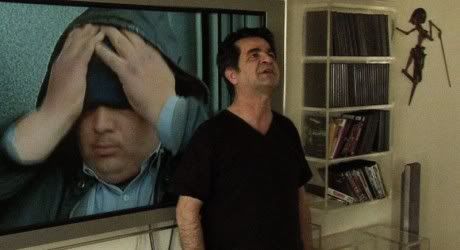
This Is Not a Film I was optimistically waiting for a truly galvanizing film-event at this year's VIFF--something along the lines of last year's Karamay or VIFF '07's Redacted, movies that (for this viewer anyway) felt instantly like game-changers. On the second-to-last day of this year's fest, that wish was granted in the form of Jafar Panahi and Mojtaba Mirahmasb's This Is Not a Film. Deceptively simple (in form and concept), the film (or non-film) is ultimately one of modern moviemaking's most thoughtful and provocative considerations of the deeply entangled, indeed inextricable personal and political dimensions of creating art. To be sure, Panahi's situation--sentenced to a six-year prison term that, in the film, he's attempting to appeal and banned from directing films for twenty years as a consequence of his involvement in the protests against Ahmadinejad's rigged reelection--is an extreme case, but the implications of This Is Not a Film extend beyond its Iranian context, as Panahi reflects on the director's relationship to, and "directing" of, his actors; the differences between "telling" a film and "making" one; and (necessarily indirectly) the moral-political responsibility inherent in making movies. Despite the dire circumstances of its creation, Panahi's film (with invaluable assistance by friend and fellow filmmaker Mirtahmasb) is as funny and vibrant as it is despairing and sad, and as triumphantly inventive as it is limited by its specific constraints. Brilliantly straddling the blurry line between spontaneous documentation and scripted narrative, This Is Not a Film is the very definition of a sui generis masterpiece.
The Turin Horse Setting aside issues of time-commitment (watching Satantango start to finish requires nearly one-third of a day), I would argue that Bela Tarr's supposed swansong is his most difficult film. Difficult--that is to say, it was considerably tougher for me to find a personal point-of-entry here than it was for Satantango, Werckmeister Harmonies, and Tarr's other earlier films--but not impenetrable, and far from unpleasurable. In fact, once I'd adapted to the fact that The Turin Horse's doom-laden narrative consists almost exclusively of a pattern of repetitions and occasional, ominously suggestive deviations (with these deviations essentially constituting the "arc")--a signature Tarr strategy here rigorously intensified to its apotheosis--I found the film to be among Tarr's most hypnotic and powerful. That said, I'm envious of Jonathan Rosenbaum, who mentions having attended three separate festival screenings of The Turin Horse in his superb Film Comment piece on the film. Of all the films I saw at this year's VIFF, this is the one I most wish I could've caught twice (or more). I'm already crossing my fingers that it will reappear in these parts sometime soon.
Are We Really So Far From a Madhouse? Li Honqi, director of last year's fest highlight Winter Vacation, returns with perhaps the most singularly bizarre musical tour documentary ever filmed. Working ostensibly within a format resistant to change or variation, Li follows the popular Chinese punk rock group P.K.14 as they drive across Mainland China, playing gigs and hanging out in hotel rooms. Right: this is, in essence, the content of every tour doc. But when the members of the band speak or perform, the audience instead hears an abrasive sonic collage of animal sounds and other strange, unidentifiable noise. Only when the group is on the road does Li pipe in their (excellent) music, as well as that of the folky spin-off Dear Eloise, creating a moody aural counterpoint to images of the Chinese highway-scape. These contemplative scenes contrast in fascinating ways with the weird energy of the animal-noise sequences. The combined result hangs together rather awkwardly and sometimes feels like radical experimentation purely for its own sake; and yet, at the same time, there is a nagging sense that something new, however cryptic, is being expressed here about the experience of a musical group trekking across the country together to perform their craft.
Le Havre Aki Kaurismaki's affectionate story of a middle-aged shoe-shiner in Normandy who aids a young African refugee wanted by the immigration authorities is charming and entirely likable. It also feels like Chicken Soup for the Aging Baby Boomer's soul. Kaurismaki and his charismatic protagonist (surname: Marx) wear their post-bohemian lefty heart on their sleeve, from the film's comically anti-authoritarian bent to nostalgic memories of Paris in the '60's. That's all fine and good, and if Le Havre's middlebrow charms translate into Oscar recognition, Kaurismaki is a decided step up from the Academy's typical taste in non-English language fare. But in bringing to the table issues of immediate relevance--illegal African migration in Europe, the Western healthcare crisis looming as the Boomer generation enters its golden years--Le Havre frustrates in its breezy reluctance to seriously consider these problems.
Martha Marcy May Marlene Sean Durkin's impressive debut feature centers on a young woman freshly escaped from a cult commune to her older sister's lake house, but is, more broadly, a dreamy meditation on the unshakability of the past within the human mind: how the people and places and moments we've known inevitably color our perception of the present--a sort of nightmare version of the Beatles' "In My Life," if you will. Elizabeth Olsen (younger sister to Mary-Kate and Ashley, but resembling in voice and presence the disaffected Scarlett Johansson of Ghost World and Lost In Translation) provides precisely the right kind of hazy, damaged, restrained yet emotionally raw turn as the titular heroine; if her performance had been remotely off the mark, Durkin's film simply wouldn't work. John Hawkes is likewise perfectly cast as the creepy, mercurial cult leader who haunts Martha's psyche. Speaking of Hawkes, Martha Marcy May Marlene follows last year's Winter's Bone in making a compelling argument for a new, reinvigorated American independent cinema that is refreshingly far from the quirky-snarky territory of Amerindies' past.
No One Killed Jessica For a viewer like myself, conditioned to the various incarnations of international festival-style (e.g., art-house) cinema, the most jarring moviegoing experience can often come in the form of an unabashedly commercial foreign movie. Raj Kumar Gupta's fictionalized take on the notorious Jessica Lall murder case feels formally alien to me--partly for the reason mentioned above and partly because my familiarity with Bollywood cinema is woefully limited--and my reaction should thus be taken with a grain of salt. The slick look and fast-paced rhythm of the film feel similar in ways to current Hollywood movies (in particular, stuff like Crash and Babel), but the on-the-nose writing, the histrionic style of acting, and the use of the weepy score registered as closer in spirit to the WWII-era Hollywood melodrama. Maybe this is how most Bollywood films feel? I really don't know. Still, I couldn't help but find the glossy form, with its oddly jokey script and abrupt use of dance and hard rock tunes on the soundtrack, disconcertingly crass in conjunction with the sad subject matter.
This Is Not a Film I was optimistically waiting for a truly galvanizing film-event at this year's VIFF--something along the lines of last year's Karamay or VIFF '07's Redacted, movies that (for this viewer anyway) felt instantly like game-changers. On the second-to-last day of this year's fest, that wish was granted in the form of Jafar Panahi and Mojtaba Mirahmasb's This Is Not a Film. Deceptively simple (in form and concept), the film (or non-film) is ultimately one of modern moviemaking's most thoughtful and provocative considerations of the deeply entangled, indeed inextricable personal and political dimensions of creating art. To be sure, Panahi's situation--sentenced to a six-year prison term that, in the film, he's attempting to appeal and banned from directing films for twenty years as a consequence of his involvement in the protests against Ahmadinejad's rigged reelection--is an extreme case, but the implications of This Is Not a Film extend beyond its Iranian context, as Panahi reflects on the director's relationship to, and "directing" of, his actors; the differences between "telling" a film and "making" one; and (necessarily indirectly) the moral-political responsibility inherent in making movies. Despite the dire circumstances of its creation, Panahi's film (with invaluable assistance by friend and fellow filmmaker Mirtahmasb) is as funny and vibrant as it is despairing and sad, and as triumphantly inventive as it is limited by its specific constraints. Brilliantly straddling the blurry line between spontaneous documentation and scripted narrative, This Is Not a Film is the very definition of a sui generis masterpiece.
The Turin Horse Setting aside issues of time-commitment (watching Satantango start to finish requires nearly one-third of a day), I would argue that Bela Tarr's supposed swansong is his most difficult film. Difficult--that is to say, it was considerably tougher for me to find a personal point-of-entry here than it was for Satantango, Werckmeister Harmonies, and Tarr's other earlier films--but not impenetrable, and far from unpleasurable. In fact, once I'd adapted to the fact that The Turin Horse's doom-laden narrative consists almost exclusively of a pattern of repetitions and occasional, ominously suggestive deviations (with these deviations essentially constituting the "arc")--a signature Tarr strategy here rigorously intensified to its apotheosis--I found the film to be among Tarr's most hypnotic and powerful. That said, I'm envious of Jonathan Rosenbaum, who mentions having attended three separate festival screenings of The Turin Horse in his superb Film Comment piece on the film. Of all the films I saw at this year's VIFF, this is the one I most wish I could've caught twice (or more). I'm already crossing my fingers that it will reappear in these parts sometime soon.
VIFF, Part 2: Good Men, Good Women
Once Upon a Time in Anatolia On the one hand, seeing Nuri Bilge Ceylan's sprawling, elusive new film in the late-night festival slot, through blood-shot eyes, seated in the extreme front right of a sold-out theater, and immediately following Ashgar Farhadi's devastating A Separation (see below) may not be the ideal vantage point from which to evaluate and discuss this strange and captivating movie; to be sure, I hope to see it again soon as an evening's main course. On the other hand, few films come to mind that lend themselves so naturally to nocturnal, and even hazy, sleep-deprived, viewing as does this long night's journey into day. Fields of wheat lit brilliant gold by the headlights of cars meandering through the pitch-dark rural night; drowsy, funny, irritable conversations that likewise zig and zag along unsure trajectories; the blurry divide between fact and fable, by turns, compressing and expanding as the sun begins to rise over the Turkish countryside--these are some of the rich ingredients that constitute Ceylan's dazzling anti-epic. To argue that Once Upon a Time in Anatolia is finally less than the sum of these parts--which may or may not be true--is, either way, to miss the point entirely.
Quattro Hong Kong 2 The MVP of this Hong Kong Film Festival-commissioned shorts collection is Open Verdict by Ho Yuhang (director of the superb, and inexplicably under-mentioned, feature At the End of the Daybreak). Shot in the smoky black and white of early Jim Jarmusch, and possessing a similarly droll sense of (visual and verbal) humor, Ho's film is a sly and playful exercise in the negotiation of national and ethnic identification in contemporary East Asia. As a Malaysian national of Chinese descent, Ho joked in his post-screening Q&A about how in Hong Kong he is typically referred to as a Malay, a term that more accurately describes Malaysia's aboriginal population. This general point regarding fuzzy trans-cultural misconceptions is clearly wired into the DNA of his story of an illegal snake-smuggling operation and the customs officers diligently, if haplessly, trying to infiltrate it. As for the the other three offerings: Apichatpong's entry, M Hotel, in which two young men sit on a hotel balcony having an unintelligible (and unsubtitled) conversation that sounds as if it were recorded underwater, is certainly interesting but essential only for "Joe" die-hards; Stanley Kwan's fine if forgettable 13 Minutes in the Life Of... charts the titular passage of time as a bus travels from the airport into the city; Brillante Mendoza's lead-off Purple, hampered by awkwardly phrased English-language voice-over work that spoils its modest verite charms, is the only dud of the bunch.
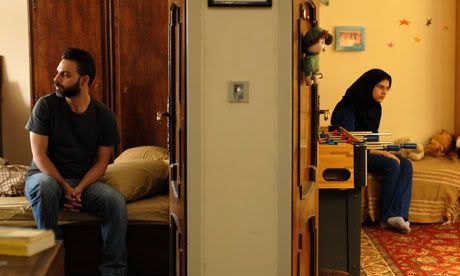
A Separation Viewed within the context of Jafar Panahi's purposefully titled This Is Not a Film (which I'll be seeing, and reporting back on, next week) and last month's arrest of six more Iranian filmmakers on "espionage" charges, Ashgar Farhadi's ferociously powerful film proves that the Iranian filmic renaissance has not yet been quashed--despite the relentless efforts of the Ahmadinejad regime. It also marks Farhadi as a major talent in contemporary cinema. As an intimate portrait of a troubled relationship (or, really, a pair of them), A Separation succeeds brilliantly where last year's Certified Copy--for which Iran's greatest director took a holiday in Tuscany--frustrates or falls flat. But the genius of Farhadi's film is how it plays equally well as an intense domestic drama (the closest thing in Iranian cinema to Cassavetes?), as a broader commentary on gender-based gaps in communication and social experience, or as a sharp, political study of the problematic coexistence of bourgeois secularism and lower-class religious fundamentalism in today's Iran. Farhadi weaves these (interdependent) discursive streams together seamlessly, leaving any number of interpretative possibilities on the table once the credits begin to roll. [Speaking of which: do not exit the theater until the screen goes black.]
A Simple Life Speaking briefly with the reviewer Robert Koehler after Ann Hui's latest, he made favorable comparisons to Ozu and Renoir. And that's hardly hyperbole. A Simple Life is one of the great family portraits--even if the film centers not on blood relatives but on the bond between a maid and her employer--in recent cinema. Hui's film is fondly affectionate and compassionate while deftly eschewing tacky sentiment; formally smart (shot by the always terrific Yu Lik-wai) but never showy or stylistically distracting; and as warmly funny as it is moving. Deannie Yip--who snagged the Best Actress prize in Venice--delivers what I expect to be the best performance I'll see at this year's fest, but a never-better Andy Lau is her pitch-perfect match.
A Time to Love Another Asian film fest-commissioned work (this one via South Korea's Jeonju International Film Festival), A Time to Love combines two medium-length takes on the romance film, both of the awkward-yet-touching variety (think, vaguely: Judd Apatow productions in a Korean setting). Boo Jiyoung's Moonwalk follows a day in the life of a middle-aged woman, killing time before heading in to work a night shift, as her romantic daydreams involving a co-worker intermingle and clash with her dreary, snow-struck reality. Yang Ikjune's Immature focuses on the "accidental" (read: too much booze) relationship formed between a twentysomething music engineer and a precocious schoolgirl, with echoes of Ghost World's Enid and Seymour (for this viewer anyway). Along the way we get damaged Ugg boots, plush cell phone danglers, a three-legged race, statutory rape charges, and a heaping helping of jjamppong.
Once Upon a Time in Anatolia On the one hand, seeing Nuri Bilge Ceylan's sprawling, elusive new film in the late-night festival slot, through blood-shot eyes, seated in the extreme front right of a sold-out theater, and immediately following Ashgar Farhadi's devastating A Separation (see below) may not be the ideal vantage point from which to evaluate and discuss this strange and captivating movie; to be sure, I hope to see it again soon as an evening's main course. On the other hand, few films come to mind that lend themselves so naturally to nocturnal, and even hazy, sleep-deprived, viewing as does this long night's journey into day. Fields of wheat lit brilliant gold by the headlights of cars meandering through the pitch-dark rural night; drowsy, funny, irritable conversations that likewise zig and zag along unsure trajectories; the blurry divide between fact and fable, by turns, compressing and expanding as the sun begins to rise over the Turkish countryside--these are some of the rich ingredients that constitute Ceylan's dazzling anti-epic. To argue that Once Upon a Time in Anatolia is finally less than the sum of these parts--which may or may not be true--is, either way, to miss the point entirely.
Quattro Hong Kong 2 The MVP of this Hong Kong Film Festival-commissioned shorts collection is Open Verdict by Ho Yuhang (director of the superb, and inexplicably under-mentioned, feature At the End of the Daybreak). Shot in the smoky black and white of early Jim Jarmusch, and possessing a similarly droll sense of (visual and verbal) humor, Ho's film is a sly and playful exercise in the negotiation of national and ethnic identification in contemporary East Asia. As a Malaysian national of Chinese descent, Ho joked in his post-screening Q&A about how in Hong Kong he is typically referred to as a Malay, a term that more accurately describes Malaysia's aboriginal population. This general point regarding fuzzy trans-cultural misconceptions is clearly wired into the DNA of his story of an illegal snake-smuggling operation and the customs officers diligently, if haplessly, trying to infiltrate it. As for the the other three offerings: Apichatpong's entry, M Hotel, in which two young men sit on a hotel balcony having an unintelligible (and unsubtitled) conversation that sounds as if it were recorded underwater, is certainly interesting but essential only for "Joe" die-hards; Stanley Kwan's fine if forgettable 13 Minutes in the Life Of... charts the titular passage of time as a bus travels from the airport into the city; Brillante Mendoza's lead-off Purple, hampered by awkwardly phrased English-language voice-over work that spoils its modest verite charms, is the only dud of the bunch.
A Separation Viewed within the context of Jafar Panahi's purposefully titled This Is Not a Film (which I'll be seeing, and reporting back on, next week) and last month's arrest of six more Iranian filmmakers on "espionage" charges, Ashgar Farhadi's ferociously powerful film proves that the Iranian filmic renaissance has not yet been quashed--despite the relentless efforts of the Ahmadinejad regime. It also marks Farhadi as a major talent in contemporary cinema. As an intimate portrait of a troubled relationship (or, really, a pair of them), A Separation succeeds brilliantly where last year's Certified Copy--for which Iran's greatest director took a holiday in Tuscany--frustrates or falls flat. But the genius of Farhadi's film is how it plays equally well as an intense domestic drama (the closest thing in Iranian cinema to Cassavetes?), as a broader commentary on gender-based gaps in communication and social experience, or as a sharp, political study of the problematic coexistence of bourgeois secularism and lower-class religious fundamentalism in today's Iran. Farhadi weaves these (interdependent) discursive streams together seamlessly, leaving any number of interpretative possibilities on the table once the credits begin to roll. [Speaking of which: do not exit the theater until the screen goes black.]
A Simple Life Speaking briefly with the reviewer Robert Koehler after Ann Hui's latest, he made favorable comparisons to Ozu and Renoir. And that's hardly hyperbole. A Simple Life is one of the great family portraits--even if the film centers not on blood relatives but on the bond between a maid and her employer--in recent cinema. Hui's film is fondly affectionate and compassionate while deftly eschewing tacky sentiment; formally smart (shot by the always terrific Yu Lik-wai) but never showy or stylistically distracting; and as warmly funny as it is moving. Deannie Yip--who snagged the Best Actress prize in Venice--delivers what I expect to be the best performance I'll see at this year's fest, but a never-better Andy Lau is her pitch-perfect match.
A Time to Love Another Asian film fest-commissioned work (this one via South Korea's Jeonju International Film Festival), A Time to Love combines two medium-length takes on the romance film, both of the awkward-yet-touching variety (think, vaguely: Judd Apatow productions in a Korean setting). Boo Jiyoung's Moonwalk follows a day in the life of a middle-aged woman, killing time before heading in to work a night shift, as her romantic daydreams involving a co-worker intermingle and clash with her dreary, snow-struck reality. Yang Ikjune's Immature focuses on the "accidental" (read: too much booze) relationship formed between a twentysomething music engineer and a precocious schoolgirl, with echoes of Ghost World's Enid and Seymour (for this viewer anyway). Along the way we get damaged Ugg boots, plush cell phone danglers, a three-legged race, statutory rape charges, and a heaping helping of jjamppong.
VIFF, Part 1: Time + Place
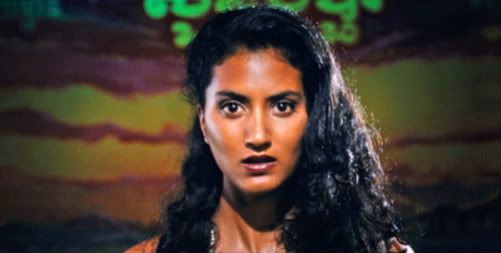
The 30th edition of the Vancouver International Film Festival is underway! Here's my first batch of capsules:
Almayer's Folly Chantal Akerman's adaptation of Joseph Conrad's 1895 novel is a masterpiece of purposefully constructed dissonance: despite the distinctly nineteenth century flavor of the narrative and especially the dialogue, the film is ostensibly set in the present; and while Akerman's vision is wholly (and astonishingly) cinematic, Almayer's Folly is also stubbornly literary, with voice-over narration read presumably straight from the source novel. Here is a story of Western colonialism (specifically, of France in Southeast Asia) compressed to its tragic, fragmentary essence and transplanted in a post-colonial present of wounds still unhealed. In the haunting final shot, the sun washes across the title character's gaunt, angular face before it is again obscured in shadow as he murmurs his regrets--a momentary consideration, and pessimistic rejection, of the possibility of redemption for the post-colonial West.
Dreileben The three films that make up this four and a half hour German omnibus--loosely structured around the occurrence of an escaped criminal stalking around a small town in the (invaluably creepy) Thuringian forest area and guided by the concept of "horizontal" storytelling wherein "the past is washed to the surface"-- vary considerably in both quality and content: The first (and best of the three), Christian Petzold's Beats Being Dead, is, initially, a charmingly intimate look at young love before an unexpected twist changes everything. The second film, Dominik Graf's Don't Follow Me Around, is a sharply comic account of old friends catching back up with one another and reflecting on their shared past. The last entry, Christoph Hocchausler's One Minute of Darkness is both where the madman-on-the-loose yarn comes to the fore (with disappointingly bland results) and where the form of the project, with its intersecting plot points and overlapping timelines, comes to feel rather schematic and overly clever. Taken individually, we've got a very good film, a respectably solid one, and a dull clunker. Yet while, under regular circumstances, two out of three would be fine, Dreileben is cursed by a sense of cohesion that, at its best, calls to mind a sort of German Twin Peaks, but that is ultimately marred by an uninspired final chapter.
Kill List Dreileben suggests the idea of a horror movie, but is, in execution something like anti-horror; the traditional elements of the genre are toyed with in such a way as to intentionally drain them of their potency. Ben Wheatley's Kill List, by contrast, morphs from a bitter domestic drama to a hard-boiled hitman flick into, finally, a legitimately frightening horror movie. The intertitles that announce the next target on the titular itinerary (e.g., "The Priest," "The Librarian," "The M.P.") at first seem superfluous, but pay off near the end, when "The Hunchback" cryptically flashes across the screen. According to the festival guide, Kill List is about "the erosion of the social contract in Britain," and the selection of assassination targets suggests a further subtext in which the Post-Modern Man has violently discarded the institutions of Religion, Academic Knowledge (a stretch, of course, if you know who "The Librarian" is!), Government, and finally the Nuclear Family. That said, this is a film that holds up best as a sly experiment in genre gear-shifting. It tends to buckle under close inspection, so why not leave well enough alone?
Koran by Heart Greg Barker's wonderful documentary centers on the 2010 International Holy Koran Competition, a huge Koran-reciting contest for which talented youths aged seven and up converge on Cairo. The obvious point of comparison here is with the Scripps National Spelling Bee and, in particular, with Jeffrey Blitz's 2002 doc Spellbound. Structurally, the two films are nearly identical: both follow the studying habits and family lives of a few young contestants leading up to the big event. But that's also just about where the similarities end. First, while spelling can be objectively judged for correctness, Koran reciting is intensely subjective and the reciters are evaluated not just for accuracy but for the "beauty" and "spirit" of their delivery. On top of this, many of the kids arriving in Egypt--from points as far afield as Maldives, Senegal, and Italy--do not speak Arabic, despite having memorized the Koran; a boy from Tajikstan, for instance, awes the judges with his "angelic" recitation, but he can neither understand Arabic nor (it is later revealed to the audience) read or write in his country's official language. In capturing these stories as they play out, Barker is vividly presenting the conflict between moderate Islam and more extreme fundamentalist interpretations, and thus considering higher cultural stakes than simply who will win the big competition. Koran by Heart, however, is never didactic or judgmental. Instead, it's very funny, genuinely touching, and uncommonly humane.
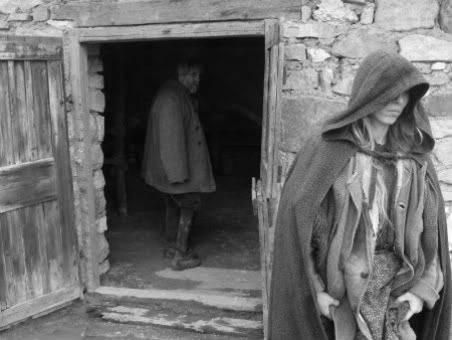
The Mill and the Cross Lech Majewski's dramatic recreation of Bruegel's 1564 painting, The Way to Cavalry, could've been a masterwork on the level of Sokurov's Russian Ark. For the first twenty minutes or so I was convinced it would be, as an art-historical world meticulously attuned to the details and rhythms of sixteenth century Flanders awakens to life in a way the distant past is so rarely able to come across on screen. Then, Majewski imposes a completely unnecessary, half-realized plot and some dubious Art History 101 dialogue between Rutger Hauer's Bruegel and a wealthy patron played by Michael York. Worse yet is the voice-over narration Majewski supplies Charlotte Rampling's mother Mary figure, in which she repeats slight variations on the line "I just don't understand..." over and over again. As one of the most visually inventive films of the digital era, The Mill and the Cross is indeed a must-see, but it's nearly as frustrating for its deficiencies as it is astonishing for its strengths.
Year without a Summer Tan Chui Mui's follow-up to her VIFF '07 highlight, Love Conquers All, is at least as accomplished, albeit even more restrained in its minimalist storytelling. The film, set in rural coastal Malaysia, focuses on the characters of Ali and Azam, while weaving back and forth between their friendship as boys and as adult men. Here, Tan is clearly drawing on the work of Southeast Asian cinema's most celebrated current practitioner. But rather than openly engaging with the mythological-supernatural dimension on screen the way Apichatpong does, this element is discussed matter-of-factly by characters, feels inextricably woven into the fabric of everyday life, and its possibility is always suggested just beyond the borders of the frame. Year Without a Summer is as lovely and, at times, hypnotic to watch as it is difficult to write about in a way that conveys some of its delicate, subtle charms; see it by all means.
The 30th edition of the Vancouver International Film Festival is underway! Here's my first batch of capsules:
Almayer's Folly Chantal Akerman's adaptation of Joseph Conrad's 1895 novel is a masterpiece of purposefully constructed dissonance: despite the distinctly nineteenth century flavor of the narrative and especially the dialogue, the film is ostensibly set in the present; and while Akerman's vision is wholly (and astonishingly) cinematic, Almayer's Folly is also stubbornly literary, with voice-over narration read presumably straight from the source novel. Here is a story of Western colonialism (specifically, of France in Southeast Asia) compressed to its tragic, fragmentary essence and transplanted in a post-colonial present of wounds still unhealed. In the haunting final shot, the sun washes across the title character's gaunt, angular face before it is again obscured in shadow as he murmurs his regrets--a momentary consideration, and pessimistic rejection, of the possibility of redemption for the post-colonial West.
Dreileben The three films that make up this four and a half hour German omnibus--loosely structured around the occurrence of an escaped criminal stalking around a small town in the (invaluably creepy) Thuringian forest area and guided by the concept of "horizontal" storytelling wherein "the past is washed to the surface"-- vary considerably in both quality and content: The first (and best of the three), Christian Petzold's Beats Being Dead, is, initially, a charmingly intimate look at young love before an unexpected twist changes everything. The second film, Dominik Graf's Don't Follow Me Around, is a sharply comic account of old friends catching back up with one another and reflecting on their shared past. The last entry, Christoph Hocchausler's One Minute of Darkness is both where the madman-on-the-loose yarn comes to the fore (with disappointingly bland results) and where the form of the project, with its intersecting plot points and overlapping timelines, comes to feel rather schematic and overly clever. Taken individually, we've got a very good film, a respectably solid one, and a dull clunker. Yet while, under regular circumstances, two out of three would be fine, Dreileben is cursed by a sense of cohesion that, at its best, calls to mind a sort of German Twin Peaks, but that is ultimately marred by an uninspired final chapter.
Kill List Dreileben suggests the idea of a horror movie, but is, in execution something like anti-horror; the traditional elements of the genre are toyed with in such a way as to intentionally drain them of their potency. Ben Wheatley's Kill List, by contrast, morphs from a bitter domestic drama to a hard-boiled hitman flick into, finally, a legitimately frightening horror movie. The intertitles that announce the next target on the titular itinerary (e.g., "The Priest," "The Librarian," "The M.P.") at first seem superfluous, but pay off near the end, when "The Hunchback" cryptically flashes across the screen. According to the festival guide, Kill List is about "the erosion of the social contract in Britain," and the selection of assassination targets suggests a further subtext in which the Post-Modern Man has violently discarded the institutions of Religion, Academic Knowledge (a stretch, of course, if you know who "The Librarian" is!), Government, and finally the Nuclear Family. That said, this is a film that holds up best as a sly experiment in genre gear-shifting. It tends to buckle under close inspection, so why not leave well enough alone?
Koran by Heart Greg Barker's wonderful documentary centers on the 2010 International Holy Koran Competition, a huge Koran-reciting contest for which talented youths aged seven and up converge on Cairo. The obvious point of comparison here is with the Scripps National Spelling Bee and, in particular, with Jeffrey Blitz's 2002 doc Spellbound. Structurally, the two films are nearly identical: both follow the studying habits and family lives of a few young contestants leading up to the big event. But that's also just about where the similarities end. First, while spelling can be objectively judged for correctness, Koran reciting is intensely subjective and the reciters are evaluated not just for accuracy but for the "beauty" and "spirit" of their delivery. On top of this, many of the kids arriving in Egypt--from points as far afield as Maldives, Senegal, and Italy--do not speak Arabic, despite having memorized the Koran; a boy from Tajikstan, for instance, awes the judges with his "angelic" recitation, but he can neither understand Arabic nor (it is later revealed to the audience) read or write in his country's official language. In capturing these stories as they play out, Barker is vividly presenting the conflict between moderate Islam and more extreme fundamentalist interpretations, and thus considering higher cultural stakes than simply who will win the big competition. Koran by Heart, however, is never didactic or judgmental. Instead, it's very funny, genuinely touching, and uncommonly humane.
The Mill and the Cross Lech Majewski's dramatic recreation of Bruegel's 1564 painting, The Way to Cavalry, could've been a masterwork on the level of Sokurov's Russian Ark. For the first twenty minutes or so I was convinced it would be, as an art-historical world meticulously attuned to the details and rhythms of sixteenth century Flanders awakens to life in a way the distant past is so rarely able to come across on screen. Then, Majewski imposes a completely unnecessary, half-realized plot and some dubious Art History 101 dialogue between Rutger Hauer's Bruegel and a wealthy patron played by Michael York. Worse yet is the voice-over narration Majewski supplies Charlotte Rampling's mother Mary figure, in which she repeats slight variations on the line "I just don't understand..." over and over again. As one of the most visually inventive films of the digital era, The Mill and the Cross is indeed a must-see, but it's nearly as frustrating for its deficiencies as it is astonishing for its strengths.
Year without a Summer Tan Chui Mui's follow-up to her VIFF '07 highlight, Love Conquers All, is at least as accomplished, albeit even more restrained in its minimalist storytelling. The film, set in rural coastal Malaysia, focuses on the characters of Ali and Azam, while weaving back and forth between their friendship as boys and as adult men. Here, Tan is clearly drawing on the work of Southeast Asian cinema's most celebrated current practitioner. But rather than openly engaging with the mythological-supernatural dimension on screen the way Apichatpong does, this element is discussed matter-of-factly by characters, feels inextricably woven into the fabric of everyday life, and its possibility is always suggested just beyond the borders of the frame. Year Without a Summer is as lovely and, at times, hypnotic to watch as it is difficult to write about in a way that conveys some of its delicate, subtle charms; see it by all means.
Pause to Reflect

Short notes on three very-good-to-great recent viewings:
Bridesmaids From Saturday Night Live and her small but memorable Adventureland role, we knew that Kristen Wiig was a formidable comedic talent. Here is proof that she can ably carry her own star vehicle. The ensemble cast of Bridesmaids--in particular, fellow SNL alum Maya Rudolph as the straight woman and bride-to-be to Wiig's hapless maid of honor, the scene-stealing ("Hey fellas, here I am, put your American sausage in my English McMuffin") Rebel Wilson, and a gravel-voiced, willfully impolite Melissa McCarthy playing against her sweet Gilmore Girls type--is uniformly good, but this is Wiig's coming out as a bona fide movie star, and she absolutely nails it. Her manic performance in a set-piece aboard an airplane warrants comparison to Lucille Ball at her hysterical best. Yet, at the same time, Wiig never over-plays her role for comic mileage, but rather creates a sympathetic, multi-dimensional character, increasingly exasperated from romantic and financial disappointments. She deserves serious awards consideration, which she, sadly, almost certainly won't receive because she's in a movie where someone shits in a sink.
Drive If I still prefer Valhalla Rising to Nicholas Winding Refn's latest, it's not for the sake of being contrary; I was frankly delighted to see a movie as deliriously strange as Drive with a (seemingly appreciative) sellout crowd at a late-night multiplex screening, and bottom line: the film's terrific. And yet, with the mostly common minimalistic narrative (non-loquacious loner develops a bond with a young boy and is driven to furious violence through grim circumstances) transplanted from the medieval world to present-day L.A., said violence registers as less organically visceral and somewhat more dubious while Refn's intense compositions (marked by frequent close-ups of his brooding protagonists) and moody soundscape feel less radical. That said, Drive--like my favorite Michael Mann films (Miami Vice, Collateral)--achieves a kind of hyper-slick, steely perfection wherein style, finally, is the substance. Bonus points for the cast of the year, including standout performers from the three best shows presently on television, an always-welcome Albert Brooks, and, of course, Ryan Gosling, furthering his case as the best (North) American actor of his generation.
Of Gods and Men Centering on the true story of French monks living in Algeria who, in 1996, were kidnapped and killed during the Algerian Civil War, Xavier Beauvois' film thoroughly succeeds as a study of both monastic devotion and post-colonial strife. Rarely on screen has the awkward collision of spirituality and the mysteries of faith with the messy sociopolitical realities of the modern world been captured so vividly. Think, for example, of Into Great Silence and Hotel Rwanda sharing film-space: Of Gods and Men is less singularly transcendent than the former and considerably more nuanced and reflective than the latter; its cumulative impact outweighs that of either earlier film. Or for another purposeful comparison: At last year's Cannes Film Festival, it won the Grand Prix to Uncle Boonmee's Palm d'Or. While Beauvois' film is, to be sure, less audaciously inventive than Apichatpong's, it's no less thoughtful and provocative as a kind of spiritual inquiry filtered through the urgency of secular concerns and processes.
Short notes on three very-good-to-great recent viewings:
Bridesmaids From Saturday Night Live and her small but memorable Adventureland role, we knew that Kristen Wiig was a formidable comedic talent. Here is proof that she can ably carry her own star vehicle. The ensemble cast of Bridesmaids--in particular, fellow SNL alum Maya Rudolph as the straight woman and bride-to-be to Wiig's hapless maid of honor, the scene-stealing ("Hey fellas, here I am, put your American sausage in my English McMuffin") Rebel Wilson, and a gravel-voiced, willfully impolite Melissa McCarthy playing against her sweet Gilmore Girls type--is uniformly good, but this is Wiig's coming out as a bona fide movie star, and she absolutely nails it. Her manic performance in a set-piece aboard an airplane warrants comparison to Lucille Ball at her hysterical best. Yet, at the same time, Wiig never over-plays her role for comic mileage, but rather creates a sympathetic, multi-dimensional character, increasingly exasperated from romantic and financial disappointments. She deserves serious awards consideration, which she, sadly, almost certainly won't receive because she's in a movie where someone shits in a sink.
Drive If I still prefer Valhalla Rising to Nicholas Winding Refn's latest, it's not for the sake of being contrary; I was frankly delighted to see a movie as deliriously strange as Drive with a (seemingly appreciative) sellout crowd at a late-night multiplex screening, and bottom line: the film's terrific. And yet, with the mostly common minimalistic narrative (non-loquacious loner develops a bond with a young boy and is driven to furious violence through grim circumstances) transplanted from the medieval world to present-day L.A., said violence registers as less organically visceral and somewhat more dubious while Refn's intense compositions (marked by frequent close-ups of his brooding protagonists) and moody soundscape feel less radical. That said, Drive--like my favorite Michael Mann films (Miami Vice, Collateral)--achieves a kind of hyper-slick, steely perfection wherein style, finally, is the substance. Bonus points for the cast of the year, including standout performers from the three best shows presently on television, an always-welcome Albert Brooks, and, of course, Ryan Gosling, furthering his case as the best (North) American actor of his generation.
Of Gods and Men Centering on the true story of French monks living in Algeria who, in 1996, were kidnapped and killed during the Algerian Civil War, Xavier Beauvois' film thoroughly succeeds as a study of both monastic devotion and post-colonial strife. Rarely on screen has the awkward collision of spirituality and the mysteries of faith with the messy sociopolitical realities of the modern world been captured so vividly. Think, for example, of Into Great Silence and Hotel Rwanda sharing film-space: Of Gods and Men is less singularly transcendent than the former and considerably more nuanced and reflective than the latter; its cumulative impact outweighs that of either earlier film. Or for another purposeful comparison: At last year's Cannes Film Festival, it won the Grand Prix to Uncle Boonmee's Palm d'Or. While Beauvois' film is, to be sure, less audaciously inventive than Apichatpong's, it's no less thoughtful and provocative as a kind of spiritual inquiry filtered through the urgency of secular concerns and processes.
Clear History: Cinemas Unfinished or Otherwise
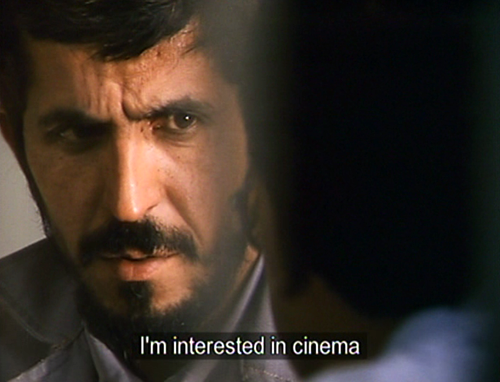
Below is a short article I contributed to a new local film journal, The Parallax. If you're around Vancouver, the debut issue--which also features thoughtful considerations of D.W. Griffith's Broken Blossoms and the films of James Gray, among other strong work--can be found at the Pacific Cinematheque and at the Vancity Theatre. If not, you can download it here.
-
Originally, I thought that the lights went out in a movie theatre so that we could see the images on the screen better. Then I looked a little closer at the audience settling comfortably into the seats and saw that there was a much more important reason: the darkness allowed the members of the audience to isolate themselves from others and to be alone. They were both with others and distant from them. When we reveal a film's world to the members of an audience, they each learn to create their own world through the wealth of their own experience.
The above is taken from the beginning of an essay by Abbas Kiarostami. Its title is "An Unfinished Cinema"; it was written in 1995 to commemorate cinema's first full century and was distributed at the Odeon Theatre in Paris. In the piece, Kiarostami discusses his reliance on "creative intervention" as a director and calls for a "half-created cinema...that gains completion through the creative spirit of the audience." He concludes by noting that "for one hundred years, cinema has belonged to the filmmaker. Let us hope that now the time has come for us to implicate the audience in its second century."
It's a provocative, perhaps overly theoretical text, on the other hand; for instance, haven't filmmakers from cinema's first century, from Bresson to Pasolini to Kiarostami himself in such films as 1990's Close-Up or his "Earthquake Trilogy" (Where Is the Friends House? [1987], Life and Nothing More... [1991], Through the Olive Trees [1994]), implicated their audience, demanded a degree of personal, cerebral leg-work to "complete" what's on the screen? Kiarostami's broad strokes seem to paint auteurist cinema as a hermetically sealed-off and fatally solipsistic landscape, turned barren from a lack of fresh oxygen. At the same time, his concession that "it is a fact that films without a story are not very popular with audiences..." refutes any claim to a populism his heady, elusive films had already amply rejected.
Such criticisms of Kiarostami's willful provocations notwithstanding, the essay, written on the cusp of the so-called "digital revolution," does feel curiously prophetic. It's not, of course, like the new technology we've become familiar with in the decade and a half since "An Unfinished Cinema"'s publication was crafted directly for the purposes of remaking or democratizing a medium now so often regarded as hopelessly twentieth century. Rather, that rapidly evolving technology has changed the way we communicate, the way he spend our leisure time, the way we get our news and information; that it's also changed the art-form heretofore known often as film as well as the ways we experience movies seems mostly incidental.
Yet as much as Kiarostami's essay seems, at first glance, to signal the sort of cinematic sea change we've witnessed in the new millennium, have these innovations finally served to make movies more open-ended and "unfinished"? Certainly the technology itself seems dizzyingly ever-evolving, as the eye-popping techniques of just two or three years ago now appear dated--another statement that extends well beyond the increasingly faintly demarcated terrain of cinema. But does wearing a pair of plastic glasses to create a 3-D effect actually qualify as implicating the audience? And while the relative cheapness of digital video has allowed an unprecedented number of would-be auteurs to enter the arena, is the work they're creating as expansively democratic as the economic or material circumstances they've benefited from?
These questions beg more questions still: Is a word like "film" still applicable when a movie has been shot digitally, or when it's being projected that way in a theatre? This generalized misnomer feels almost comparable to one asking for "a Coke," but meaning (and correctly receiving), say, Dr. Pepper or Sprite or ginger ale. Which is to say, do such distinctions even matter to viewers who aren't either industry specialists or nitpicking cinephiles? Certainly, the quality of the movie-watching experience seems to matter to a lot of people, given the popularity of Blu-Ray and the proliferation of massive high-definition televisions and consumer-grade digital home projection.
Yet at the same time, more and more movies are also being viewed on laptops and cellular phone screens. Forget celluloid versus digital arguments: does it even still count as "watching a movie" in any traditional sense when, instead of Kiarostami's hypothetical darkened theatre, the images are flickering across a screen that fits comfortably in your pocket while you ride the bus or the subway? The musings of wiser commentators than myself suggest that everything in the second decade of the new millennium--from where we live and work to what we eat and drink to how we consume media and entertainment--is an extension of "lifestyle." In this view, cinema is, at best, a disposable topic of online conversation, roughly as important, as, say, whether one prefers Macs to PCs, rides a bike to work or drives their car.
The ubiquity of 3-D aside, Hollywood has changed remarkably little alongside these significant cultural shifts. Movies like Avatar, the Harry Potter and Twilight films, and Pixar's annual efforts have earned their studios handsome sums of money, so why fix what's not broken? That's over-simplifying the state of contemporary mainstream movie-making, to be sure, but independent (or, really, quasi- or pseduo-independent) film has, for better or worse, proven far more representative of what has changed since the time of Kiarostami's essay. What's emerged from the margins has been a decidedly mixed bag.
Take, for example, Jonathan Caouette's Tarnation, Banksy's Exit Through the Gift Shop, and Henry Joost and Ariel Schulman's Catfish--each the product of new technology and/or new ways of transmitting information and, to varying degrees, each worthy of praise or interest. But to what extent do these films fulfill Kiarstami's urge for "gaps, empty spaces like a crossword puzzle, voids that it is up to the audience to fill in"? Tarnation does present Caouette's singular life story as a kind of fragmented mystery, using a Mac computer program to assemble archival footage and pop cultural miscellanea into a vivid collage of trauma. And yet it's at least as impenetrably solipsistic as the auteur-centered work Kiarostami implicitly criticizes as that mode of yesteryear. Exit Through the Gift Shop is nearly as spry and playful in its study of authenticity in art as Welles's great F for Fake, but any extent to which it actually implicates the audience depends entirely on that audience's pre-existing familiarity with, or willingness to scour the Internet for, the fuzzy details of its conception.(Ironically, Banksy's film addresses many of the same concerns as Kiarostami's latest, Certified Copy, but Exit is slyly self-aware and terrifically funny where Certified Copy is schematic and muddled.) Catfish asks some of the same questions, as well, but rather than open-ended or "half-created," Joost and Schulman's film is manipulative and overly slick in its design, if deceptively amateurish in its execution. It's also shot through with a brand of smarmy meanness that's recognizably symptomatic of the Internet Age.
The films of Jia Zhangke and Kelly Reichardt seem to get closer to the kind of cinema Kiarostami is describing. Over the dozen years between 1998's Xiao Wu and last year's I Wish I Knew, Jia has consistently blurred the lines between narrative and non-narrative, fiction and documentary, actors and "real-life people" (also a reoccuring Kiarostami preoccupation); at his best, he's able to capture the very cadence of modern life from the vantage point of the world's most populous and rapidly developing nation. Reichardt, meanwhile, is perhaps the brightest light to have emerged this past decade from within the American independent movement. In a film like Wendy and Lucy, where Reichardt almost completely eschews exposition or telling her audience what to feel, we can, at once, hear the echoes of Bresson and Mizoguchi and see a promising path for the future of cinema. It's a cinema that's personal but not sealed-off, modest but not minor, eager to involve its audience both emotionally and intellectually without neatly categorizing such engagements--and it is exquisitely, invigoratingly unfinished.
Below is a short article I contributed to a new local film journal, The Parallax. If you're around Vancouver, the debut issue--which also features thoughtful considerations of D.W. Griffith's Broken Blossoms and the films of James Gray, among other strong work--can be found at the Pacific Cinematheque and at the Vancity Theatre. If not, you can download it here.
-
Originally, I thought that the lights went out in a movie theatre so that we could see the images on the screen better. Then I looked a little closer at the audience settling comfortably into the seats and saw that there was a much more important reason: the darkness allowed the members of the audience to isolate themselves from others and to be alone. They were both with others and distant from them. When we reveal a film's world to the members of an audience, they each learn to create their own world through the wealth of their own experience.
The above is taken from the beginning of an essay by Abbas Kiarostami. Its title is "An Unfinished Cinema"; it was written in 1995 to commemorate cinema's first full century and was distributed at the Odeon Theatre in Paris. In the piece, Kiarostami discusses his reliance on "creative intervention" as a director and calls for a "half-created cinema...that gains completion through the creative spirit of the audience." He concludes by noting that "for one hundred years, cinema has belonged to the filmmaker. Let us hope that now the time has come for us to implicate the audience in its second century."
It's a provocative, perhaps overly theoretical text, on the other hand; for instance, haven't filmmakers from cinema's first century, from Bresson to Pasolini to Kiarostami himself in such films as 1990's Close-Up or his "Earthquake Trilogy" (Where Is the Friends House? [1987], Life and Nothing More... [1991], Through the Olive Trees [1994]), implicated their audience, demanded a degree of personal, cerebral leg-work to "complete" what's on the screen? Kiarostami's broad strokes seem to paint auteurist cinema as a hermetically sealed-off and fatally solipsistic landscape, turned barren from a lack of fresh oxygen. At the same time, his concession that "it is a fact that films without a story are not very popular with audiences..." refutes any claim to a populism his heady, elusive films had already amply rejected.
Such criticisms of Kiarostami's willful provocations notwithstanding, the essay, written on the cusp of the so-called "digital revolution," does feel curiously prophetic. It's not, of course, like the new technology we've become familiar with in the decade and a half since "An Unfinished Cinema"'s publication was crafted directly for the purposes of remaking or democratizing a medium now so often regarded as hopelessly twentieth century. Rather, that rapidly evolving technology has changed the way we communicate, the way he spend our leisure time, the way we get our news and information; that it's also changed the art-form heretofore known often as film as well as the ways we experience movies seems mostly incidental.
Yet as much as Kiarostami's essay seems, at first glance, to signal the sort of cinematic sea change we've witnessed in the new millennium, have these innovations finally served to make movies more open-ended and "unfinished"? Certainly the technology itself seems dizzyingly ever-evolving, as the eye-popping techniques of just two or three years ago now appear dated--another statement that extends well beyond the increasingly faintly demarcated terrain of cinema. But does wearing a pair of plastic glasses to create a 3-D effect actually qualify as implicating the audience? And while the relative cheapness of digital video has allowed an unprecedented number of would-be auteurs to enter the arena, is the work they're creating as expansively democratic as the economic or material circumstances they've benefited from?
These questions beg more questions still: Is a word like "film" still applicable when a movie has been shot digitally, or when it's being projected that way in a theatre? This generalized misnomer feels almost comparable to one asking for "a Coke," but meaning (and correctly receiving), say, Dr. Pepper or Sprite or ginger ale. Which is to say, do such distinctions even matter to viewers who aren't either industry specialists or nitpicking cinephiles? Certainly, the quality of the movie-watching experience seems to matter to a lot of people, given the popularity of Blu-Ray and the proliferation of massive high-definition televisions and consumer-grade digital home projection.
Yet at the same time, more and more movies are also being viewed on laptops and cellular phone screens. Forget celluloid versus digital arguments: does it even still count as "watching a movie" in any traditional sense when, instead of Kiarostami's hypothetical darkened theatre, the images are flickering across a screen that fits comfortably in your pocket while you ride the bus or the subway? The musings of wiser commentators than myself suggest that everything in the second decade of the new millennium--from where we live and work to what we eat and drink to how we consume media and entertainment--is an extension of "lifestyle." In this view, cinema is, at best, a disposable topic of online conversation, roughly as important, as, say, whether one prefers Macs to PCs, rides a bike to work or drives their car.
The ubiquity of 3-D aside, Hollywood has changed remarkably little alongside these significant cultural shifts. Movies like Avatar, the Harry Potter and Twilight films, and Pixar's annual efforts have earned their studios handsome sums of money, so why fix what's not broken? That's over-simplifying the state of contemporary mainstream movie-making, to be sure, but independent (or, really, quasi- or pseduo-independent) film has, for better or worse, proven far more representative of what has changed since the time of Kiarostami's essay. What's emerged from the margins has been a decidedly mixed bag.
Take, for example, Jonathan Caouette's Tarnation, Banksy's Exit Through the Gift Shop, and Henry Joost and Ariel Schulman's Catfish--each the product of new technology and/or new ways of transmitting information and, to varying degrees, each worthy of praise or interest. But to what extent do these films fulfill Kiarstami's urge for "gaps, empty spaces like a crossword puzzle, voids that it is up to the audience to fill in"? Tarnation does present Caouette's singular life story as a kind of fragmented mystery, using a Mac computer program to assemble archival footage and pop cultural miscellanea into a vivid collage of trauma. And yet it's at least as impenetrably solipsistic as the auteur-centered work Kiarostami implicitly criticizes as that mode of yesteryear. Exit Through the Gift Shop is nearly as spry and playful in its study of authenticity in art as Welles's great F for Fake, but any extent to which it actually implicates the audience depends entirely on that audience's pre-existing familiarity with, or willingness to scour the Internet for, the fuzzy details of its conception.(Ironically, Banksy's film addresses many of the same concerns as Kiarostami's latest, Certified Copy, but Exit is slyly self-aware and terrifically funny where Certified Copy is schematic and muddled.) Catfish asks some of the same questions, as well, but rather than open-ended or "half-created," Joost and Schulman's film is manipulative and overly slick in its design, if deceptively amateurish in its execution. It's also shot through with a brand of smarmy meanness that's recognizably symptomatic of the Internet Age.
The films of Jia Zhangke and Kelly Reichardt seem to get closer to the kind of cinema Kiarostami is describing. Over the dozen years between 1998's Xiao Wu and last year's I Wish I Knew, Jia has consistently blurred the lines between narrative and non-narrative, fiction and documentary, actors and "real-life people" (also a reoccuring Kiarostami preoccupation); at his best, he's able to capture the very cadence of modern life from the vantage point of the world's most populous and rapidly developing nation. Reichardt, meanwhile, is perhaps the brightest light to have emerged this past decade from within the American independent movement. In a film like Wendy and Lucy, where Reichardt almost completely eschews exposition or telling her audience what to feel, we can, at once, hear the echoes of Bresson and Mizoguchi and see a promising path for the future of cinema. It's a cinema that's personal but not sealed-off, modest but not minor, eager to involve its audience both emotionally and intellectually without neatly categorizing such engagements--and it is exquisitely, invigoratingly unfinished.
Every Which Way But Loose (or Any Which Way You Can?)

What we used to call "albums":
Lady Gaga, Born This Way So, is this it? The moment when Gaga the persona stopped being interesting because Gaga the person (it's slipped through the cracks despite her best efforts at playing the blank slate) isn't? While the moment itself was inevitable, I assumed the music, which never felt secondary to her celebrity until now, had legs enough to carry her a couple years further. Not that this record is bad, or as boring as the socially well-meaning but insufferably self-serious young woman promoting it on the interview circuit. In fact, there's plenty to like, yet, to these ears anyway, nothing to love. Hell, I'd take "Just Dance" Akon-an'-all over anything on Born This Way, not to speak of "Paparazzi," "Bad Romance," "Telephone," even "Boys Boys Boys." I still like the idea of Gaga and, more importantly, the aforementioned songs enough to not give up on her. She certainly cares, which is a good thing, but maybe it's possible to give too much of a fuck?
Britney Spears, Femme Fatale If Britney's latest is less ferociously meta-personal than the phoenix-from-the-ashes triumphs of Blackout and Circus, it's at least as through-inspired, perhaps more so than the latter. If you omit the Will.i.am dud sandwiched in the middle, it might be the most start-to-finish sparkling dance-pop collection since Kylie's Fever. Britney's never been more locked into the groove than she is here; her signature-thin vocal never gets lost in the mix, but rather flits and weaves expertly around it. Oh, and there's songs here, too. And they're really good. See: "I Wanna Go," "'Til the World Ends," "Inside Out." Then see: "Criminal," "How I Roll," and "Trip to Your Heart." It's like a perfect dream of pop presided over by an artist old enough, and (yes) smart enough, to know better but damn good enough at what she does for a living to keep the party going for the better part of an hour.
The Mountain Goats, All Eternals Deck Six tracks in, I was ready to, again, write about "the best Mountain Goats record since the last one" and call it a day--nothing lost, nothing gained except another entirely fine Darnielle disc. Then--voila!--a song called "High Hawk Season" instantly rewrote the blurb you're reading, like an out-of-nowhere eleventh-hour comeback that forces a sportswriter to scrap the game recap he'd almost finished writing. Backed by a vocal trio listed as the North Mountain Singers, the song sounds like nothing else in the extensive Mountain Goats catalogue. Upon repeat listens, Darnielle and Co. are trying new things all over this album, just more subtly than on the singularly beautiful "High Hawk Season." He isn't just our most consistently excellent songwriter. He's an artist who remains stunningly capable of changing the game. And All Eternals Deck isn't just "the best Mountain Goats record since the last one"--it's up there with Tallahassee and The Sunset Tree.
Brad Paisley, This Is Country Music From a promising Nashville up-and-comer. this would earn high marks. From Brad Paisley? We expect more, which is our problem but his fault: His last--what, four? five?--records, excluding the guitar curio, have upped the ante exponentially, not just setting the standard for radio country but expanding it in ways that feel as natural as they do meaningful. There's a reason why rock critics who typically avoid Nashville fare christened American Saturday Night as something of a cause celebre. Me? I like country music just fine without Brad's boundary-blurring smarts, though more with them. And they're not absent from this record, mainly because Paisley is more articulate in his trad move than his less clever contemporaries are trying to play cool. This Is Country Music is only reactionary insofar as it subtly implies that the broader scope of Paisley's recent work might not be.
What we used to call "albums":
Lady Gaga, Born This Way So, is this it? The moment when Gaga the persona stopped being interesting because Gaga the person (it's slipped through the cracks despite her best efforts at playing the blank slate) isn't? While the moment itself was inevitable, I assumed the music, which never felt secondary to her celebrity until now, had legs enough to carry her a couple years further. Not that this record is bad, or as boring as the socially well-meaning but insufferably self-serious young woman promoting it on the interview circuit. In fact, there's plenty to like, yet, to these ears anyway, nothing to love. Hell, I'd take "Just Dance" Akon-an'-all over anything on Born This Way, not to speak of "Paparazzi," "Bad Romance," "Telephone," even "Boys Boys Boys." I still like the idea of Gaga and, more importantly, the aforementioned songs enough to not give up on her. She certainly cares, which is a good thing, but maybe it's possible to give too much of a fuck?
Britney Spears, Femme Fatale If Britney's latest is less ferociously meta-personal than the phoenix-from-the-ashes triumphs of Blackout and Circus, it's at least as through-inspired, perhaps more so than the latter. If you omit the Will.i.am dud sandwiched in the middle, it might be the most start-to-finish sparkling dance-pop collection since Kylie's Fever. Britney's never been more locked into the groove than she is here; her signature-thin vocal never gets lost in the mix, but rather flits and weaves expertly around it. Oh, and there's songs here, too. And they're really good. See: "I Wanna Go," "'Til the World Ends," "Inside Out." Then see: "Criminal," "How I Roll," and "Trip to Your Heart." It's like a perfect dream of pop presided over by an artist old enough, and (yes) smart enough, to know better but damn good enough at what she does for a living to keep the party going for the better part of an hour.
The Mountain Goats, All Eternals Deck Six tracks in, I was ready to, again, write about "the best Mountain Goats record since the last one" and call it a day--nothing lost, nothing gained except another entirely fine Darnielle disc. Then--voila!--a song called "High Hawk Season" instantly rewrote the blurb you're reading, like an out-of-nowhere eleventh-hour comeback that forces a sportswriter to scrap the game recap he'd almost finished writing. Backed by a vocal trio listed as the North Mountain Singers, the song sounds like nothing else in the extensive Mountain Goats catalogue. Upon repeat listens, Darnielle and Co. are trying new things all over this album, just more subtly than on the singularly beautiful "High Hawk Season." He isn't just our most consistently excellent songwriter. He's an artist who remains stunningly capable of changing the game. And All Eternals Deck isn't just "the best Mountain Goats record since the last one"--it's up there with Tallahassee and The Sunset Tree.
Brad Paisley, This Is Country Music From a promising Nashville up-and-comer. this would earn high marks. From Brad Paisley? We expect more, which is our problem but his fault: His last--what, four? five?--records, excluding the guitar curio, have upped the ante exponentially, not just setting the standard for radio country but expanding it in ways that feel as natural as they do meaningful. There's a reason why rock critics who typically avoid Nashville fare christened American Saturday Night as something of a cause celebre. Me? I like country music just fine without Brad's boundary-blurring smarts, though more with them. And they're not absent from this record, mainly because Paisley is more articulate in his trad move than his less clever contemporaries are trying to play cool. This Is Country Music is only reactionary insofar as it subtly implies that the broader scope of Paisley's recent work might not be.
Sight and Sound
I've had a couple good conversations recently on the best uses of pop music in movies and on television, so I've decided to post some of my favorite examples. These are culled from what's available on YouTube, and they're just off the top of my head, not listed in any sort of preferential order. I've been rather wordy lately, so I'll just let the sounds and images in the clips posted below speak for themselves. Enjoy!
"The Rhythm of the Night" by Corona in Beau Travail
"The Great Gig in the Sky" by Pink Floyd in Good Morning, Night (at 1:40)
"Only You" by the Flying Pickets in Fallen Angels (at 2:40)
"California Dreamin'" by the Mamas and the Papas in Chungking Express
"Eyes on the Prize" by The Emmaus Group Singers in Green Card (at 2:40)
"Come Here" by Kath Bloom in Before Sunrise
"Be My Baby" by the Ronettes in Mean Streets (at 0:42)
"Take Me Home, Country Roads" (originally by John Denver) in Whisper of the Heart
"Oh Yoko" by John Lennon in Rushmore (at 1:10)
"Young Americans" by David Bowie in Dogville
"Pale Blue Eyes" by the Velvet Underground in Adventureland (at 2:41; embedding disabled)
"Sinnerman" by Nina Simone in Inland Empire (embedding disabled)
"Don't Stop Believin'" by Journey in The Sopranos (at 0:54)
"Overcome" by Live in The Shield
"The Happiest Girl in the Whole U.S.A." by Daveigh Chase in Big Love
"Babylon" by David Carbonara in Mad Men (embedding disabled)
"Wild Horses" by the Sundays in Buffy the Vampire Slayer (embedding disabled)
I've had a couple good conversations recently on the best uses of pop music in movies and on television, so I've decided to post some of my favorite examples. These are culled from what's available on YouTube, and they're just off the top of my head, not listed in any sort of preferential order. I've been rather wordy lately, so I'll just let the sounds and images in the clips posted below speak for themselves. Enjoy!
"The Rhythm of the Night" by Corona in Beau Travail
"The Great Gig in the Sky" by Pink Floyd in Good Morning, Night (at 1:40)
"Only You" by the Flying Pickets in Fallen Angels (at 2:40)
"California Dreamin'" by the Mamas and the Papas in Chungking Express
"Eyes on the Prize" by The Emmaus Group Singers in Green Card (at 2:40)
"Come Here" by Kath Bloom in Before Sunrise
"Be My Baby" by the Ronettes in Mean Streets (at 0:42)
"Take Me Home, Country Roads" (originally by John Denver) in Whisper of the Heart
"Oh Yoko" by John Lennon in Rushmore (at 1:10)
"Young Americans" by David Bowie in Dogville
"Pale Blue Eyes" by the Velvet Underground in Adventureland (at 2:41; embedding disabled)
"Sinnerman" by Nina Simone in Inland Empire (embedding disabled)
"Don't Stop Believin'" by Journey in The Sopranos (at 0:54)
"Overcome" by Live in The Shield
"The Happiest Girl in the Whole U.S.A." by Daveigh Chase in Big Love
"Babylon" by David Carbonara in Mad Men (embedding disabled)
"Wild Horses" by the Sundays in Buffy the Vampire Slayer (embedding disabled)
Write Not Riot

As a fan of great, inventive sports writing, Grantland, the brainchild of the compulsively readable Bill Simmons, is something of a dream come true. Check out Simmons on the Stanley Cup finals (still a good read, after the fact); Jay Caspian Kang on the exquisite corpse of LeBron James; Chuck Klosterman on the NBA's bizarre-when-you-stop-to-think-about-it halfcourt rule; and Chris Jones on what the Stanley Cup means to Canadian cities.
On that last note, as a sports fan living in the beautiful city of Vancouver, I truly appreciate the smart, thoughtful content of Grantland as an antidote to the depressing idiocy of the riots that erupted here following the Canucks' Game 7 loss. On the game itself, I have fairly little to add: The Canucks appeared gassed, nervous, and stiff, while the Bruins looked like they were playing with the house's money. But, really, the writing was on the wall, and many fans here just refused to recognize it. The key stats heading into Game 7 weren't so much that the home team had won the first six games or that the team that scored first had gone on to victory in each game. Rather, it was that if you disregard the impossibly tight first two games played here, the Bruins had won three of the past four and outscored the Canucks 17-4 over that span. With this in mind, the deciding game felt as inevitable as it did dispiriting, though not finally as dispiriting as watching your city get smashed and burned by a bunch of macho-posturing losers.
As a fan of great, inventive sports writing, Grantland, the brainchild of the compulsively readable Bill Simmons, is something of a dream come true. Check out Simmons on the Stanley Cup finals (still a good read, after the fact); Jay Caspian Kang on the exquisite corpse of LeBron James; Chuck Klosterman on the NBA's bizarre-when-you-stop-to-think-about-it halfcourt rule; and Chris Jones on what the Stanley Cup means to Canadian cities.
On that last note, as a sports fan living in the beautiful city of Vancouver, I truly appreciate the smart, thoughtful content of Grantland as an antidote to the depressing idiocy of the riots that erupted here following the Canucks' Game 7 loss. On the game itself, I have fairly little to add: The Canucks appeared gassed, nervous, and stiff, while the Bruins looked like they were playing with the house's money. But, really, the writing was on the wall, and many fans here just refused to recognize it. The key stats heading into Game 7 weren't so much that the home team had won the first six games or that the team that scored first had gone on to victory in each game. Rather, it was that if you disregard the impossibly tight first two games played here, the Bruins had won three of the past four and outscored the Canucks 17-4 over that span. With this in mind, the deciding game felt as inevitable as it did dispiriting, though not finally as dispiriting as watching your city get smashed and burned by a bunch of macho-posturing losers.
Das Champion

Congratulations to the Dallas Mavericks, 2011's deserving NBA champions. As a Lakers fan, it's validating, if not comforting, to see the Mavs dispatch the Heat in six. And besides, it's nice to see Dirk and Kidd finally score some rings.
And what have we learned this postseason?
The league's New Guard hasn't quite usurped its Old Guard, despite early signs to the contrary. Yes, the Spurs, Celtics, and Lakers fell early (though the latter to another veteran club), but Derrick Rose and Kevin Durant couldn't will their teams past the semis and LeBron remains ring-less.
This, of course, is the biggest story of these Finals, more than Dirk (who can now officially no longer be accused of being soft or wilting under pressure), Kidd (who might now have the edge on Steve Nash for best point guard of their generation), Cuban (David Stern must be thrilled), Wade (who has already won a ring at the Mavs' expense), and Bosh (who exceeded expectations, where LeBron succumbed to them). LeBron was fine tonight--certainly better than the measly eight points he contributed in Game 4. But fine is simply not good enough for the game's supposed premier talent--and for a dude so egocentric (or, more likely, poorly advised) that he starred in an ESPN special declaring his "decision" to "take [his] talents to South Beach" last offseason.
Look, I like LeBron, and as a fan of the NBA and of exciting basketball in general, I want to watch with amazement when this undeniably phenomenal athlete finds that extra gear and takes over in pivotal moments. But how much longer do we keep giving him the benefit of the doubt that such a gear exists in his arsenal? And how much longer can LeBron remain the league's signature star (give or take an aging Kobe) without winning a championship? If, for instance, this Heat experiment doesn't deliver over the next few seasons, and in that time, Durant and/or D-Rose succeed, can we still with a straight face call this guy "King"? Wouldn't he just be one of those obscenely-rich-but-effectively-for-show royals (like the present-day British monarchy)?
That's all hypothetical, natch. The trio of LeBron, Wade, and Bosh came within two wins of a title their first season together. They might very well win it all next year. Yet even then, if it's either (or both) of the latter two players who are primarily to credit in the clutch, that LBJ question mark will likely remain.
More importantly (to me, right now), here's to hoping that tomorrow evening, another Western Conference team that wears blue and green and is attempting to reverse a history of futility prevails in their Game 6 on the East Coast....(Go Canucks Go!)
Congratulations to the Dallas Mavericks, 2011's deserving NBA champions. As a Lakers fan, it's validating, if not comforting, to see the Mavs dispatch the Heat in six. And besides, it's nice to see Dirk and Kidd finally score some rings.
And what have we learned this postseason?
The league's New Guard hasn't quite usurped its Old Guard, despite early signs to the contrary. Yes, the Spurs, Celtics, and Lakers fell early (though the latter to another veteran club), but Derrick Rose and Kevin Durant couldn't will their teams past the semis and LeBron remains ring-less.
This, of course, is the biggest story of these Finals, more than Dirk (who can now officially no longer be accused of being soft or wilting under pressure), Kidd (who might now have the edge on Steve Nash for best point guard of their generation), Cuban (David Stern must be thrilled), Wade (who has already won a ring at the Mavs' expense), and Bosh (who exceeded expectations, where LeBron succumbed to them). LeBron was fine tonight--certainly better than the measly eight points he contributed in Game 4. But fine is simply not good enough for the game's supposed premier talent--and for a dude so egocentric (or, more likely, poorly advised) that he starred in an ESPN special declaring his "decision" to "take [his] talents to South Beach" last offseason.
Look, I like LeBron, and as a fan of the NBA and of exciting basketball in general, I want to watch with amazement when this undeniably phenomenal athlete finds that extra gear and takes over in pivotal moments. But how much longer do we keep giving him the benefit of the doubt that such a gear exists in his arsenal? And how much longer can LeBron remain the league's signature star (give or take an aging Kobe) without winning a championship? If, for instance, this Heat experiment doesn't deliver over the next few seasons, and in that time, Durant and/or D-Rose succeed, can we still with a straight face call this guy "King"? Wouldn't he just be one of those obscenely-rich-but-effectively-for-show royals (like the present-day British monarchy)?
That's all hypothetical, natch. The trio of LeBron, Wade, and Bosh came within two wins of a title their first season together. They might very well win it all next year. Yet even then, if it's either (or both) of the latter two players who are primarily to credit in the clutch, that LBJ question mark will likely remain.
More importantly (to me, right now), here's to hoping that tomorrow evening, another Western Conference team that wears blue and green and is attempting to reverse a history of futility prevails in their Game 6 on the East Coast....(Go Canucks Go!)
Who Will Survive in America?
Wendy and Lucy--the 2008 film that represented a giant step forward and the arrival of a major auteur in Kelly Reichardt--told the story of a young woman (Michelle Williams) trying to make it up to Alaska, but who gets stuck on the way in a small Oregon town, without money, without resources, and without her dog, Lucy. Many admirers at the time remarked upon the fruitful coincidence of this hard-luck tale appearing right in the midst of America's worst recession since the Great Depression. But such serendipity aside, Reichardt's larger concerns were the potentially dangerous myth of upward mobility and the "American Dream," how easily ordinary people can fall helplessly between the cracks, and where the promising frontiers of our collective imagination end and prosaic reality begins. Yet none of this is ever directly articulated or hammered home in big, histrionic moments; Wendy and Lucy is never not the story of a woman trying to get back the dog she loves very much. It's shot through with a sort of Bressonian grace, and it's quietly devastating.
Meek's Cutoff is set in 1845, more than a century and a half before the present-day Wendy and Lucy. Both films, however, take place in Oregon (albeit in the case of Meek's Cutoff, 14 years before Oregon would be incorporated as the U.S.'s 33rd state--characters in the film speculate whether the territory will "go American"). Reichardt, an East Coast native, seems acutely fascinated by the space that the West Coast and, in particular, Oregon and the Northwest occupy within the American cultural psyche. Way off on the continental margin, it's a land that's stranger and less quintessentially "American" than Boston or New York or Philadelphia, while ostensibly promising opportunity and danger in roughly equal measure. There's a peculiar sense of deja vu in Reichardt's Oregon, of struggles endured and inevitably forgotten over time against the backdrop of an unfeeling physical landscape.
The problems encountered by Wendy are of a decidedly contemporary nature (chiefly, the absence of a solid social safety net). Those faced by the small company of immigrant pioneers in Meek's Cutoff are more dire: increasing shortages of food and water; innumerable miles of travel in a harsh desert terrain; the looming threat posed by the region's Native inhabitants; and maybe most of all, the unreliability of their contracted guide, the titular Stephen Meek. As played by Bruce Greenwood (reminiscent of Daniel Day-Lewis' charismatically sinister There Will Be Blood turn, though more reined-in and sparingly deployed), Meek is arrogant and mercurial, insisting, when his sense of direction is questioned, that "we're not lost, we're just finding our way." His most vocal critic, Emily Tetherow (again, Michelle Williams, who is fast becoming the De Niro to Reichardt's Scorsese), wonders aloud to her more mild-mannered husband (Will Patton) whether Meek is "ignorant or just plain evil."
If Meek is one of the great ambiguous screen villains of recent years, Williams' Emily, following Jennifer Lawrence's Ree Dolly in Debra Granik's marvelous Winter's Bone, is one of American cinema's most compelling feminist creations. As in her previous work, Reichardt is understated in her politics, making engrossing movies first and polemical statements second, but here, she's clearly interested in the evolution of female agency in American society and how that connects to or correlates with the extreme circumstances of the pioneer experience. In Meek's Cutoff, the men of the group huddle together making tenuous plans for their company's troubled passage, while we, the audience, remain amongst their wives and later a Native captive--just barely, or sometimes not quite, within earshot. We are privy, however, to private conversations between Emily and her husband. From these moments, it becomes clear that she's actually the one calling the shots and that she has an impeccable bullshit detector.
It's tempting to read Meek's Cutoff as a kind of historical prequel to Wendy and Lucy, with the outsize expectations of Manifest Destiny, of limitless gold and fertile land, evolving into Wendy's vague hopes regarding the even further frontier of Alaska. One of Reichardt's favorite motifs is the nocturnal campfire, that archetypal forum for pipe-dream myths to take shape before they soon evaporate in the light of day. Her latest makes excellent use of both these night-time gatherings (with Meek's over-confident tall tales taking on a ghostly quality in the flickering fire-light) and the oppressive, sweltering sun of the days that follow. Meek's Cutoff is unshowily gorgeous--often, at once, painterly and palpably grimy. The film's unforgettable final scene brings Reichardt's myriad concerns to a pointed head, closing on an image that's as haunting as the last shot of Ford's The Searchers.
Wendy and Lucy--the 2008 film that represented a giant step forward and the arrival of a major auteur in Kelly Reichardt--told the story of a young woman (Michelle Williams) trying to make it up to Alaska, but who gets stuck on the way in a small Oregon town, without money, without resources, and without her dog, Lucy. Many admirers at the time remarked upon the fruitful coincidence of this hard-luck tale appearing right in the midst of America's worst recession since the Great Depression. But such serendipity aside, Reichardt's larger concerns were the potentially dangerous myth of upward mobility and the "American Dream," how easily ordinary people can fall helplessly between the cracks, and where the promising frontiers of our collective imagination end and prosaic reality begins. Yet none of this is ever directly articulated or hammered home in big, histrionic moments; Wendy and Lucy is never not the story of a woman trying to get back the dog she loves very much. It's shot through with a sort of Bressonian grace, and it's quietly devastating.
Meek's Cutoff is set in 1845, more than a century and a half before the present-day Wendy and Lucy. Both films, however, take place in Oregon (albeit in the case of Meek's Cutoff, 14 years before Oregon would be incorporated as the U.S.'s 33rd state--characters in the film speculate whether the territory will "go American"). Reichardt, an East Coast native, seems acutely fascinated by the space that the West Coast and, in particular, Oregon and the Northwest occupy within the American cultural psyche. Way off on the continental margin, it's a land that's stranger and less quintessentially "American" than Boston or New York or Philadelphia, while ostensibly promising opportunity and danger in roughly equal measure. There's a peculiar sense of deja vu in Reichardt's Oregon, of struggles endured and inevitably forgotten over time against the backdrop of an unfeeling physical landscape.
The problems encountered by Wendy are of a decidedly contemporary nature (chiefly, the absence of a solid social safety net). Those faced by the small company of immigrant pioneers in Meek's Cutoff are more dire: increasing shortages of food and water; innumerable miles of travel in a harsh desert terrain; the looming threat posed by the region's Native inhabitants; and maybe most of all, the unreliability of their contracted guide, the titular Stephen Meek. As played by Bruce Greenwood (reminiscent of Daniel Day-Lewis' charismatically sinister There Will Be Blood turn, though more reined-in and sparingly deployed), Meek is arrogant and mercurial, insisting, when his sense of direction is questioned, that "we're not lost, we're just finding our way." His most vocal critic, Emily Tetherow (again, Michelle Williams, who is fast becoming the De Niro to Reichardt's Scorsese), wonders aloud to her more mild-mannered husband (Will Patton) whether Meek is "ignorant or just plain evil."
If Meek is one of the great ambiguous screen villains of recent years, Williams' Emily, following Jennifer Lawrence's Ree Dolly in Debra Granik's marvelous Winter's Bone, is one of American cinema's most compelling feminist creations. As in her previous work, Reichardt is understated in her politics, making engrossing movies first and polemical statements second, but here, she's clearly interested in the evolution of female agency in American society and how that connects to or correlates with the extreme circumstances of the pioneer experience. In Meek's Cutoff, the men of the group huddle together making tenuous plans for their company's troubled passage, while we, the audience, remain amongst their wives and later a Native captive--just barely, or sometimes not quite, within earshot. We are privy, however, to private conversations between Emily and her husband. From these moments, it becomes clear that she's actually the one calling the shots and that she has an impeccable bullshit detector.
It's tempting to read Meek's Cutoff as a kind of historical prequel to Wendy and Lucy, with the outsize expectations of Manifest Destiny, of limitless gold and fertile land, evolving into Wendy's vague hopes regarding the even further frontier of Alaska. One of Reichardt's favorite motifs is the nocturnal campfire, that archetypal forum for pipe-dream myths to take shape before they soon evaporate in the light of day. Her latest makes excellent use of both these night-time gatherings (with Meek's over-confident tall tales taking on a ghostly quality in the flickering fire-light) and the oppressive, sweltering sun of the days that follow. Meek's Cutoff is unshowily gorgeous--often, at once, painterly and palpably grimy. The film's unforgettable final scene brings Reichardt's myriad concerns to a pointed head, closing on an image that's as haunting as the last shot of Ford's The Searchers.
Waiting for the Man
Adam Cook, over at Cinemezzo, has invited some guest writers, including yours truly, to reflect on Terrence Malick's first four features in feverish anticipation of The Tree of Life. The feature kicks off tomorrow, May 21st, with Edwin Davies of Hope Lies at 24 Frames Per Second covering Badlands; my contribution on Days of Heaven will run this coming Monday; our gracious host's piece on The Thin Red Line will follow on Wednesday; and an essay on The New World by Nathaniel Smith, also of Hope Lies..., will bring us up to date on Friday.
So stay tuned for that, if you're so inclined.
Adam Cook, over at Cinemezzo, has invited some guest writers, including yours truly, to reflect on Terrence Malick's first four features in feverish anticipation of The Tree of Life. The feature kicks off tomorrow, May 21st, with Edwin Davies of Hope Lies at 24 Frames Per Second covering Badlands; my contribution on Days of Heaven will run this coming Monday; our gracious host's piece on The Thin Red Line will follow on Wednesday; and an essay on The New World by Nathaniel Smith, also of Hope Lies..., will bring us up to date on Friday.
So stay tuned for that, if you're so inclined.
Subscribe to:
Posts (Atom)