Every Which Way But Loose (or Any Which Way You Can?)


What we used to call "albums":

Lady Gaga, Born This Way So, is this it? The moment when Gaga the persona stopped being interesting because Gaga the person (it's slipped through the cracks despite her best efforts at playing the blank slate) isn't? While the moment itself was inevitable, I assumed the music, which never felt secondary to her celebrity until now, had legs enough to carry her a couple years further. Not that this record is bad, or as boring as the socially well-meaning but insufferably self-serious young woman promoting it on the interview circuit. In fact, there's plenty to like, yet, to these ears anyway, nothing to love. Hell, I'd take "Just Dance" Akon-an'-all over anything on Born This Way, not to speak of "Paparazzi," "Bad Romance," "Telephone," even "Boys Boys Boys." I still like the idea of Gaga and, more importantly, the aforementioned songs enough to not give up on her. She certainly cares, which is a good thing, but maybe it's possible to give too much of a fuck?

Britney Spears, Femme Fatale If Britney's latest is less ferociously meta-personal than the phoenix-from-the-ashes triumphs of Blackout and Circus, it's at least as through-inspired, perhaps more so than the latter. If you omit the Will.i.am dud sandwiched in the middle, it might be the most start-to-finish sparkling dance-pop collection since Kylie's Fever. Britney's never been more locked into the groove than she is here; her signature-thin vocal never gets lost in the mix, but rather flits and weaves expertly around it. Oh, and there's songs here, too. And they're really good. See: "I Wanna Go," "'Til the World Ends," "Inside Out." Then see: "Criminal," "How I Roll," and "Trip to Your Heart." It's like a perfect dream of pop presided over by an artist old enough, and (yes) smart enough, to know better but damn good enough at what she does for a living to keep the party going for the better part of an hour.

The Mountain Goats, All Eternals Deck Six tracks in, I was ready to, again, write about "the best Mountain Goats record since the last one" and call it a day--nothing lost, nothing gained except another entirely fine Darnielle disc. Then--voila!--a song called "High Hawk Season" instantly rewrote the blurb you're reading, like an out-of-nowhere eleventh-hour comeback that forces a sportswriter to scrap the game recap he'd almost finished writing. Backed by a vocal trio listed as the North Mountain Singers, the song sounds like nothing else in the extensive Mountain Goats catalogue. Upon repeat listens, Darnielle and Co. are trying new things all over this album, just more subtly than on the singularly beautiful "High Hawk Season." He isn't just our most consistently excellent songwriter. He's an artist who remains stunningly capable of changing the game. And All Eternals Deck isn't just "the best Mountain Goats record since the last one"--it's up there with Tallahassee and The Sunset Tree.

Brad Paisley, This Is Country Music From a promising Nashville up-and-comer. this would earn high marks. From Brad Paisley? We expect more, which is our problem but his fault: His last--what, four? five?--records, excluding the guitar curio, have upped the ante exponentially, not just setting the standard for radio country but expanding it in ways that feel as natural as they do meaningful. There's a reason why rock critics who typically avoid Nashville fare christened American Saturday Night as something of a cause celebre. Me? I like country music just fine without Brad's boundary-blurring smarts, though more with them. And they're not absent from this record, mainly because Paisley is more articulate in his trad move than his less clever contemporaries are trying to play cool. This Is Country Music is only reactionary insofar as it subtly implies that the broader scope of Paisley's recent work might not be.
Sight and Sound


I've had a couple good conversations recently on the best uses of pop music in movies and on television, so I've decided to post some of my favorite examples. These are culled from what's available on YouTube, and they're just off the top of my head, not listed in any sort of preferential order. I've been rather wordy lately, so I'll just let the sounds and images in the clips posted below speak for themselves. Enjoy!


"The Rhythm of the Night" by Corona in Beau Travail


"The Great Gig in the Sky" by Pink Floyd in Good Morning, Night (at 1:40)


"Only You" by the Flying Pickets in Fallen Angels (at 2:40)


"California Dreamin'" by the Mamas and the Papas in Chungking Express


"Eyes on the Prize" by The Emmaus Group Singers in Green Card (at 2:40)


"Come Here" by Kath Bloom in Before Sunrise


"Be My Baby" by the Ronettes in Mean Streets (at 0:42)


"Take Me Home, Country Roads" (originally by John Denver) in Whisper of the Heart


"Oh Yoko" by John Lennon in Rushmore (at 1:10)


"Young Americans" by David Bowie in Dogville

"Pale Blue Eyes" by the Velvet Underground in Adventureland
(at 2:41; embedding disabled)

"Sinnerman" by Nina Simone in Inland Empire (embedding disabled)


"Don't Stop Believin'" by Journey in The Sopranos (at 0:54)


"Overcome" by Live in The Shield


"The Happiest Girl in the Whole U.S.A." by Daveigh Chase in Big Love

"Babylon" by David Carbonara in Mad Men (embedding disabled)

"Wild Horses" by the Sundays in Buffy the Vampire Slayer (embedding disabled)
Write Not Riot


As a fan of great, inventive sports writing, Grantland, the brainchild of the compulsively readable Bill Simmons, is something of a dream come true. Check out Simmons on the Stanley Cup finals (still a good read, after the fact); Jay Caspian Kang on the exquisite corpse of LeBron James; Chuck Klosterman on the NBA's bizarre-when-you-stop-to-think-about-it halfcourt rule; and Chris Jones on what the Stanley Cup means to Canadian cities.

On that last note, as a sports fan living in the beautiful city of Vancouver, I truly appreciate the smart, thoughtful content of Grantland as an antidote to the depressing idiocy of the riots that erupted here following the Canucks' Game 7 loss. On the game itself, I have fairly little to add: The Canucks appeared gassed, nervous, and stiff, while the Bruins looked like they were playing with the house's money. But, really, the writing was on the wall, and many fans here just refused to recognize it. The key stats heading into Game 7 weren't so much that the home team had won the first six games or that the team that scored first had gone on to victory in each game. Rather, it was that if you disregard the impossibly tight first two games played here, the Bruins had won three of the past four and outscored the Canucks 17-4 over that span. With this in mind, the deciding game felt as inevitable as it did dispiriting, though not finally as dispiriting as watching your city get smashed and burned by a bunch of macho-posturing losers.
Das Champion


Congratulations to the Dallas Mavericks, 2011's deserving NBA champions. As a Lakers fan, it's validating, if not comforting, to see the Mavs dispatch the Heat in six. And besides, it's nice to see Dirk and Kidd finally score some rings.

And what have we learned this postseason?

The league's New Guard hasn't quite usurped its Old Guard, despite early signs to the contrary. Yes, the Spurs, Celtics, and Lakers fell early (though the latter to another veteran club), but Derrick Rose and Kevin Durant couldn't will their teams past the semis and LeBron remains ring-less.

This, of course, is the biggest story of these Finals, more than Dirk (who can now officially no longer be accused of being soft or wilting under pressure), Kidd (who might now have the edge on Steve Nash for best point guard of their generation), Cuban (David Stern must be thrilled), Wade (who has already won a ring at the Mavs' expense), and Bosh (who exceeded expectations, where LeBron succumbed to them). LeBron was fine tonight--certainly better than the measly eight points he contributed in Game 4. But fine is simply not good enough for the game's supposed premier talent--and for a dude so egocentric (or, more likely, poorly advised) that he starred in an ESPN special declaring his "decision" to "take [his] talents to South Beach" last offseason.

Look, I like LeBron, and as a fan of the NBA and of exciting basketball in general, I want to watch with amazement when this undeniably phenomenal athlete finds that extra gear and takes over in pivotal moments. But how much longer do we keep giving him the benefit of the doubt that such a gear exists in his arsenal? And how much longer can LeBron remain the league's signature star (give or take an aging Kobe) without winning a championship? If, for instance, this Heat experiment doesn't deliver over the next few seasons, and in that time, Durant and/or D-Rose succeed, can we still with a straight face call this guy "King"? Wouldn't he just be one of those obscenely-rich-but-effectively-for-show royals (like the present-day British monarchy)?

That's all hypothetical, natch. The trio of LeBron, Wade, and Bosh came within two wins of a title their first season together. They might very well win it all next year. Yet even then, if it's either (or both) of the latter two players who are primarily to credit in the clutch, that LBJ question mark will likely remain.

More importantly (to me, right now), here's to hoping that tomorrow evening, another Western Conference team that wears blue and green and is attempting to reverse a history of futility prevails in their Game 6 on the East Coast....(Go Canucks Go!)
Who Will Survive in America?


Wendy and Lucy--the 2008 film that represented a giant step forward and the arrival of a major auteur in Kelly Reichardt--told the story of a young woman (Michelle Williams) trying to make it up to Alaska, but who gets stuck on the way in a small Oregon town, without money, without resources, and without her dog, Lucy. Many admirers at the time remarked upon the fruitful coincidence of this hard-luck tale appearing right in the midst of America's worst recession since the Great Depression. But such serendipity aside, Reichardt's larger concerns were the potentially dangerous myth of upward mobility and the "American Dream," how easily ordinary people can fall helplessly between the cracks, and where the promising frontiers of our collective imagination end and prosaic reality begins. Yet none of this is ever directly articulated or hammered home in big, histrionic moments; Wendy and Lucy is never not the story of a woman trying to get back the dog she loves very much. It's shot through with a sort of Bressonian grace, and it's quietly devastating.

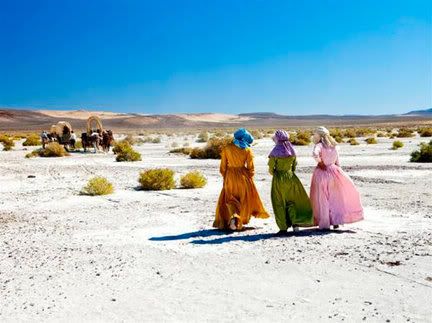
Meek's Cutoff is set in 1845, more than a century and a half before the present-day Wendy and Lucy. Both films, however, take place in Oregon (albeit in the case of Meek's Cutoff, 14 years before Oregon would be incorporated as the U.S.'s 33rd state--characters in the film speculate whether the territory will "go American"). Reichardt, an East Coast native, seems acutely fascinated by the space that the West Coast and, in particular, Oregon and the Northwest occupy within the American cultural psyche. Way off on the continental margin, it's a land that's stranger and less quintessentially "American" than Boston or New York or Philadelphia, while ostensibly promising opportunity and danger in roughly equal measure. There's a peculiar sense of deja vu in Reichardt's Oregon, of struggles endured and inevitably forgotten over time against the backdrop of an unfeeling physical landscape.

The problems encountered by Wendy are of a decidedly contemporary nature (chiefly, the absence of a solid social safety net). Those faced by the small company of immigrant pioneers in Meek's Cutoff are more dire: increasing shortages of food and water; innumerable miles of travel in a harsh desert terrain; the looming threat posed by the region's Native inhabitants; and maybe most of all, the unreliability of their contracted guide, the titular Stephen Meek. As played by Bruce Greenwood (reminiscent of Daniel Day-Lewis' charismatically sinister There Will Be Blood turn, though more reined-in and sparingly deployed), Meek is arrogant and mercurial, insisting, when his sense of direction is questioned, that "we're not lost, we're just finding our way." His most vocal critic, Emily Tetherow (again, Michelle Williams, who is fast becoming the De Niro to Reichardt's Scorsese), wonders aloud to her more mild-mannered husband (Will Patton) whether Meek is "ignorant or just plain evil."

If Meek is one of the great ambiguous screen villains of recent years, Williams' Emily, following Jennifer Lawrence's Ree Dolly in Debra Granik's marvelous Winter's Bone, is one of American cinema's most compelling feminist creations. As in her previous work, Reichardt is understated in her politics, making engrossing movies first and polemical statements second, but here, she's clearly interested in the evolution of female agency in American society and how that connects to or correlates with the extreme circumstances of the pioneer experience. In Meek's Cutoff, the men of the group huddle together making tenuous plans for their company's troubled passage, while we, the audience, remain amongst their wives and later a Native captive--just barely, or sometimes not quite, within earshot. We are privy, however, to private conversations between Emily and her husband. From these moments, it becomes clear that she's actually the one calling the shots and that she has an impeccable bullshit detector.

It's tempting to read Meek's Cutoff as a kind of historical prequel to Wendy and Lucy, with the outsize expectations of Manifest Destiny, of limitless gold and fertile land, evolving into Wendy's vague hopes regarding the even further frontier of Alaska. One of Reichardt's favorite motifs is the nocturnal campfire, that archetypal forum for pipe-dream myths to take shape before they soon evaporate in the light of day. Her latest makes excellent use of both these night-time gatherings (with Meek's over-confident tall tales taking on a ghostly quality in the flickering fire-light) and the oppressive, sweltering sun of the days that follow. Meek's Cutoff is unshowily gorgeous--often, at once, painterly and palpably grimy. The film's unforgettable final scene brings Reichardt's myriad concerns to a pointed head, closing on an image that's as haunting as the last shot of Ford's The Searchers.
Waiting for the Man


Adam Cook, over at Cinemezzo, has invited some guest writers, including yours truly, to reflect on Terrence Malick's first four features in feverish anticipation of The Tree of Life. The feature kicks off tomorrow, May 21st, with Edwin Davies of Hope Lies at 24 Frames Per Second covering Badlands; my contribution on Days of Heaven will run this coming Monday; our gracious host's piece on The Thin Red Line will follow on Wednesday; and an essay on The New World by Nathaniel Smith, also of Hope Lies..., will bring us up to date on Friday.

So stay tuned for that, if you're so inclined.
"Shh, Don't Look at Them"


When we're out doing things--running errands, going for a walk, getting a bite to eat, etc.--and our two and a half year-old son visibly needs an in-stroller nap and seems on the verge of nodding off, one of us will say, "Shh, don't look at him." Which means, of course, stop talking for a moment, don't make eye contact, and hopefully the lack of visual and aural stimulation will allow him to him to relax and fall asleep. Sometimes, this strategy works. Other times, he gets more restless and fussy, annoyed that we're ignoring him, and ends up throwing repeated tantrums that don't seem to be about anything in particular (I know--he's 2, that's what they do). When this happens, it's retrospectively clear that we should've further investigated why he wasn't quite falling asleep in the first place--did he need a cup of milk, perhaps, to help soothe him, or maybe a quick run around somewhere to burn off the excess energy keeping him awake?

I mention this because a similar (ultimately ineffective) policy of "Shh, don't look at them!" seemed to apply to this season's Lakers, who were humiliated in a four-game sweep by the Dallas Mavericks. From the players and coaching staff themselves to the sports media and fans, the general attitude all season seemed to be one of looking the other way when significant problems arose. Blown out by the horrendous Cavs (a team that set the record for the longest losing streak in league history)? "Don't worry about it, it's just the regular season." Inching within contention of the West's top seed, then sleep-walking through games and barely holding on to the 2-seed on the final day of the season? "Sure, they don't look great now, but they're the two-time defending champs--they know what they're doing." Losing two games to a Hornets team that, without David West, was basically just Chris Paul and a bunch of spare parts? "They're playing down to a mediocre opponent. They'll 'turn it on' when it counts."

And...here we are.

What actually happened to the 2010-11 Lakers is something of a mystery. Because hardly anyone bothered to ask the tough questions months or weeks ago, it's probably too late to conclusively know now; it's certainly too late to matter. What is readily apparent is that you can't just "turn it on" in April or May and expect everything to be fine. The similarly aging Spurs found that out in the first round, and the Lakers likely would've, too, had they drawn Memphis instead of New Orleans. Yet, while age seems to be the single biggest factor in the Spurs' early exit, can the same really be said of the Lakers? Father Time can't, by himself and within a single year, turn two-time NBA champs into a lifeless bunch of non-starters who couldn't manage one measly second-round win against a not-that-great Dallas team. Ditto the line-of-thinking that blames a lack of team chemistry; the core of the team remained identical to last year's.

One also can't attribute the sweep, or today's demoralizing blow-out, to the absence of identifiable motivators. If your legendary coach attempting, in his final season, a book-ending fourth threepeat and your franchise star trying to tie Jordan's ring-count (and thus merit mention in best-ever discussions) aren't motivation enough, I'm not sure what more could possibly be needed.

Whatever the case, barring major off-season shake-ups, things don't look terribly bright for the brave new post-Jackson Lakers world...
Victory Lap


In Bill Simmons' introduction to his Book of Basketball (a terrific read, by the way, recommended to all NBA fans), he mentions a conversation he had with Isiah Thomas concerning the so-called "secret of basketball." Simmons pressed Thomas for an answer to this elusive question, and Thomas responded that "the secret of baksetball is that it's not about basketball," but rather about teamwork, chemistry, and myriad other elements not directly related to putting the ball in the hoop. While this, at first, might sound slightly cryptic, it makes sense and probably applies equally to most other team sports (baseball, where an individual pitcher or hitter can almost single-handedly win games, might be a bit of an exception, though over a 162-game season, the "secret" certainly factors in to some extent).

With that in mind, the secret of Friday Night Lights the TV series was that this show about high school football was really about everything else: family, both in the literal and broader definitions of the word; the social health of a community; what we give to and take from the relationships we forge; personal responsibility and integrity; the role of education in American life; the state of race relations in the South; the way that where we live serves to shape who we are--these, more than touchdowns, field goals, and state championships, were the ingredients that made Friday Night Lights such an indelible work of art.

And that's also why watching the show's final season is such a bittersweet experience. It means saying goodbye to Dillon, Texas, the Taylor family, the Riggins brothers, Buddy Garrity and the boosters, the Alamo Freeze--the whole nine yards (no pun intended). This is something the cast and crew of the series seemed to anticipate and probably feel themselves. Season 5 is fittingly wistful, as warm and often heartbreakingly tender a final act as any devoted fan could've hoped for. This is especially true of the last couple episodes where we're given just enough resolution, but also a kind of poetic open-endedness that suggests unwritten futures, allowing these people we've come to love to live on in our collective imagination. The decisions arrived at by Matt and Julie and by Coach and Tami seem, together, to encapsulate the very heart of the show.

This season also did a superb job of balancing the more recent East Dillon characters and storylines with the return of original cast members. Seeing Jason and Tyra back in Dillon made for a very satisfying surprise. Their appearances didn't feel shoe-horned in either, but fit naturally into the current narrative; while I would've liked to have seen Smash and Lyla come back, as well, too many reappearances might've sidetracked the focus of the season. My only (very minor) gripe is that the new characters introduced this season didn't feel all that necessary; little was done with the Hastings character after successfully recruiting him to join the Lions and Epic mostly seemed to serve as a cipher to illustrate Tami's inclusive educational philosophy. But with such rich developments in the lives of Vince, Jess, Becky, Billy and Mindy, and everyone else, this small point hardly matters. Friday Night Lights was one of television's great dramas and it will be sincerely missed.
Brothers in Arms


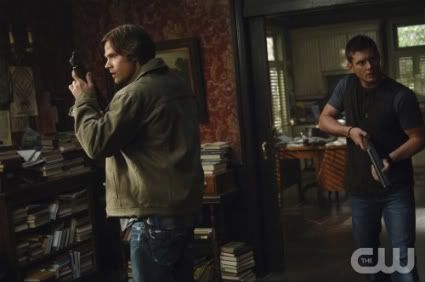
My latest obsession: Supernatural. Having never followed the show over the past years of its run, I've played quick catch-up, burning through Season 1-4 over the past month. Consider me converted; as a serious admirer of Joss Whedon's work, especially Buffy and Angel, Eric Kripke's series is the next-best thing in terms of a fantasy-horror series with an absorbing and well-developed mythology and increasingly multi-dimensional characters dealing with demons both personal and literal. While Kripke has clearly been influenced by Whedon's approach--particularly with regard to Supernatural's seamless integration of comedy, drama, and horror elements and mix of stand-alone "concept" episodes with arc-driven narrative--the universe and personalities he's crafted are richly their own.

One of the most remarkable aspects of the show is its feel for an Americana, at once, of-this-moment and smartly aware of decades' worth of American history. The first names of protagonist brothers Sam and Dean Winchester imply an earlier era when such simple, monosyllabic male names were more common; the rifle-manufacturing connotation of their surname, meanwhile, suggests the subtextual genre Kripke is also slyly drawing on: the Hollywood Western (the same form Whedon relocated to outer space with Firefly). Yet rather than a pair of horses, Sam and Dean traverse the country in a black '67 Impala, blaring (mostly '70's and early '80's) classic rock from the cassette deck. The effect of these elements is a sort of blurred timelessness that's only rendered present-tense through the brothers' 21st Century dependence upon cell-phones and laptop computers.

The other nifty trick that Supernatural pulls off is convincing us that one week Sam and Dean are in Wisconsin, the next Wyoming, and the week after that Ohio, when every episode save for the pilot has actually been shot right here in Greater Vancouver. Initially, as a Vancouverite, this was a little distracting, as I tried, with occasional success, to spot local locations (including a cemetery in "Upstate New York" that's actually just up the street from my house). But as I became progressively engrossed in the world of the series, I was mostly able to suspend disbelief; after all, if I can momentarily accept that ghosts and demons exist, it shouldn't be too much of a stretch to buy that some non-descript suburb of Vancouver is small-town Indiana, right? It helps significantly that Kripke nails virtually every other detail of Americana, while using Vancouver's oft-grey skies to compliment the show's moody textures.

To be sure, this is a dark show even when the demons aren't on-screen, but it's also one of the great works in film or television about the dynamics of brotherhood, as tender as it is thorny. It's a story as ancient and elemental as Cain and Abel. Sam and Dean are, by disposition and world-view, drastically different men: the former is sulky and cerebral, the latter extroverted and pragmatic. And yet the shared experience of their upbringing bonds them together in a way that's virtually impenetrable to everyone else. They don't always get along swimmingly, but they're constantly aware (and, frankly, terrified) of how lost one would be without the other. This blood-bond--the subject of so many great Westerns and other classic American films and novels--is strengthened further by the fact that Sam and Dean are, first effectively and later in the series literally, orphans: all they've really got is each other and they know it. The nomadic nature of their lifestyle (driving all across the Lower 48 in search of their next non-human nemesis; Dean's afraid to fly) coupled with the danger and strangeness of their profession (they refer to it as "hunting") prevent them from forming any other lasting relationships, aside from with other "hunters"--a necessity they both eventually acknowledge and begrudgingly accept.

The first season, like most debut runs, is largely concerned with introducing the primary ingredients: Sam and Dean are just about the only reoccurring characters, Kripke's specific version of horror mythology is established, and the episodes are mini-horror movies centered on a demon-of-the-week, with a connective arc only hinted at until the final few episodes. The episodes range in quality from merely fine to very good and even moderately scary, as such famous villains as Bloody Mary, the Wendigo, and the Hook Man square off against Sam and Dean. The best of these, "Scarecrow," borrows from the chilling idea behind Shirley Jackson's "The Lottery," as a small Midwestern town makes annual human sacrifices to a pagan god. All things considered, it's probably as good as Buffy's first season, if not quite Angel's, which worked from the advantage of our familiarity with most of the principals and thus required less time for exposition.

Supernatural's second season is where the show truly hits its stride. The master-narrative tantalizingly introduced near the end of the first season drives the momentum, giving the follow-up season a real sense of urgency from start to finish. And the "stand-alone" episodes (a misleading categorization, since they all serve to further the show's central themes of brotherhood and duty, if not the season-specific arc) are often legitimately powerful. "Heart," in which Sam and Dean try to cure a young woman who has been made a werewolf, is one of the most devastating hours of television I've ever seen; its final scene, in particular, is brilliantly-staged and utterly haunting. The third season, woefully shortened by six episodes due to the Writer's Guild strike, is nevertheless nearly as strong.

One of the most interesting dichotomies established over the first three seasons of Supernatural is between faith (Sam is a Believer and regularly prays) and agnosticism (Dean repeatedly states that he believes only in what he has seen, which includes ghosts, demons, vampires, and werewolves--but not God or angels). It's a constant source of tension between the two brothers, surfacing again and again, from a first-season episode involving a corrupt faith healer to a later one, where the ghost of a renegade priest must be stopped.

That's why I cringed a little when, in the fourth season opener, an angel resurrects Dean (who died in the third season finale), claiming that he's part of God's grand design. This seemed to mark a bold, potentially dubious commitment on Kripke's part and, inevitably, ended the on-going debate mentioned above. But over the next few episodes, it gradually becomes clear that this development is actually Kripke's most subversive move to date. The angels, we soon realize, aren't benevolent guardians of human-kind. Rather, they're a cultish, militaristic force operating mostly on blind faith and big-picture fatalism. One "fallen" angel tells Dean that only four angels have actually seen God and that they must suppress any and all emotion because such feelings are the "pathways to doubt." Often, in fighting their eternal war against Lucifer's army of demons, hundreds or even thousands of innocent human lives are shrugged off as mere collateral damage; the critique slyly embedded in this depiction of brutish angels and a decidedly Old Testament God seems also to extend beyond religion and toward fanatical nationalism or even unregulated capitalism. That such an argument could be made--I won't push it further until I've watch the fifth and sixth seasons, which could very conceivably offer more curveballs--without requiring too much critical stretching is certainly saying something. In fact, it seems nothing short of radical for a CW series about hunky brothers driving around in a classic muscle car fighting ghosts and monsters.
Lion in Winter


Film Socialisme, Godard's latest feature, is among his densest, most allusive, and perplexing; fans mostly familiar with Godard via the recent 50th Anniversary re-release of Breathless or from his iconic '60's work in general may want to exercise a certain degree of caution. But for fellow admirers of Godard's late-career mode (from Histoire(s) du Cinema on), this is very much a natural aesthetic extension and another masterpiece. It's also, it should be noted, at least as spry and playful and consistently surprising as it is "difficult" or "impenetrable."

And that's not to deny that it indeed is both of those things, but it's incredibly beautiful, too, as sensuous and vigorous as, say, My Life to Live or Two or Three Things I Know About Her, maybe even more so. It's identifiably the work of a pessimistic octogenarian intellectual, yet one who still sees some glimmer of hope in a generation too young to know the historical deck is stacked against them; the second part of this triptych is loosely constructed as a kind of tribunal (against the backdrop of a French gas station), where kids hold their parents and grandparents accountable for the problems with the world they'll soon inherit.

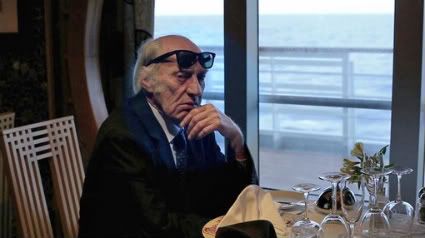
The first and third sections deal with a cruise ship's voyage west from Cairo, with stops in the Levant, Barcelona, and Naples, among other destinations. The passengers aboard (mainly Europeans and a few Americans, including Patti Smith, with the ship's employees seemingly from Southeast Asia) are mostly oblivious to their surroundings, as they discuss issues pertinent to Europe's past, present, and future. I was reminded early on of Vigo's L'Atalante but progressively more of Manoel de Oliveira's A Talking Picture, another autumnal masterwork, with Godard's fractured passage taking the reverse route from de Oliveira's fated West-East travelogue.

As with all late Godard, we're left with far more questions (or ideas) than answers, though that may be even truer for Film Socialisme. I hope to see this one again soon, ideally with the more precise English subtitles that a fan has reportedly supplied online. The official release version is paired with what Godard has mischievously called "Navajo subtitles"--that is, extremely simplistic English, usually two or three words standing in for audibly more long-winded French dialogue. It's initially quite frustrating, but it also, perhaps, speaks to the disconnectedness of Godard's cipher-characters from the problematic politics and histories of their holiday ports of call. Or maybe it's a commentary on the English-speaking world's ignorance of the intricacies of Mainland European culture? Either way, it's yet more food for thought in a film you certainly won't walk away from hungry.
Great Expectations


Two-thirds of my favorite band in the world ever + the great Mary Timony: I'm psyched.

According to this Village Voice piece on Carrie Brownstein, WILD FLAG (apparently, it's supposed to be written in all caps) are aiming for an August release for their debut record and playing some shows in the meantime.

In the article, Brownstein also talks a little about the tantalizing prospect of a reunion with the Sleater-Kinney member not in her new group. "I definitely feel like that is in our future [hooray!], but it's not even in the realm of possibility right now [damn]." Well, here's to hoping that WILD FLAG will tide us over until that magical moment comes.
No Girl So Sweet


It's rare, at this point, to read an article or hear a commentator speak about Madonna without mentioning her knack for reinvention, but PJ Harvey deserves nearly as much credit for doing over almost-two decades on the semi-pop sidelines what Madge has done over almost-three decades front-and-center. The key difference between the two isn't 10 or so years of maintained relevance--any time we're talking decades-plural in such a fickle industry, that's certainly rarefied air. Rather, it's that Madonna has reinvented her music and image along a trajectory more or less consistent with the pulse of Euro-American popular culture, sometimes dictating the next steps and other times playing quick catch-up. Harvey, on the other hand, has forged a path entirely her own, and keeping with her legendarily private nature, one that's largely, willfully oblivious to whatever else is going on. Back in 2007, was ghostly Victorian chamber music burning up your playlist? Was 2011 supposed to be the year of the macabre "war album," grimly looking back on the First World War and considering its far-reaching consequences on the development of the English nation? Well, tough shit. Because with all due respect to Madonna (and Prince and Springsteen and Sleater-Kinney and Jay-Z, et al), Polly Jean Harvey is nothing less than the supreme musical artist of my lifetime.

Let England Shake is another masterpiece in a career impossibly full of them, and it could hardly be more different than its predecessor, the under-appreciated White Chalk. The first four songs clearly stake out Harvey's musical terrain and lyrical concerns this time out. The title track opener is a deceptively jangly piece, simultaneously a soldier's wife's lament as prelude ("Another day, Bobby, for you to come home") for the war scenes to come and an epilogue-as-preface ("The West's asleep, let England shake / weighted down with silent dead / I fear our blood won't rise again") to the discomfiting material she's tackling. The next number, "The Last Living Rose," establishes the album's blackly nostalgic tone as she opens with, "Goddamn Europeans / take me back to beautiful England," then a little later, "Let me walk through the stinking alleys / to the music of drunken beatings"; this is not a nationalistic ode to Merrie Old England, as evidenced further by the next track's scarily catchy call-and-response chant, "What is the glorious fruit of our land? / Its fruit is deformed children." And then on the stunning "The Words That Maketh Murder," she invokes Eddie Cochran, turning an off-handed lyric into a desperately repeated plea in the doomed hope of exorcising more than just the "Summertime Blues": "What if I take my problem to the United Nations?" (Bringing her oeuvre full circle, I was reminded of the South Pacific-borrowed and similarly recontextualized "I'm gonna wash that man right outta my hair" from her breakthrough classic "Sheela-Na-Gig.")

Of course, Harvey has never been Miss Mary Sunshine, from "don't you wish you never met her?" to "I know these chalk hills will rot my bones"; excepting the fleeting romance of Stories from the City, Stories from the Sea, she's modern music's consummate pessimist. But for an artist who insisted early on not to be labeled a "feminist" and who has always been more concerned with personal drama (whether her own or that of the characters she seamlessly inhabits) than with the broader socio-cultural sphere, this is her first unabashedly political record. And yet it feels no less urgently personal than anything in her catalogue. The music is gorgeous and melodic, in purposefully stark contrast to the harrowing subjects of these songs. Her words are eerily imagistic, as on lead-off single "Written on the Forehead," where over a reggae sample, Harvey sings, "Date palms, orange / and tangerine trees / and eyes are crying / for everything." This is the hypnotic soundtrack to a great, blistering anti-war film that exists only in Polly Jean Harvey's singular imagination. Its connection to the modern world--and not just Harvey's native England, but Iran, Egypt, Afghanistan, America and beyond--is the truly disturbing part.
Make This Happen, Part II


Five reasons why this really needs to happen--and hopefully sooner rather than later:

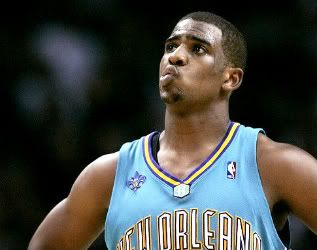
01. Since the Grizzlies moved to Memphis in 2001, Vancouverites missed out on the renaissance of NBA talent over the past decade: just for starters, LeBron James, Dwayne Wade, Carmelo Anthony, Dwight Howard, Kevin Durant, Deron Williams, and Chris Paul, who (at least in theory--messy contract realities aside) would play 41 games a year here in beautiful British Columbia if the Hornets indeed relocated to Vancouver.

02. Portland is too far to travel to catch an NBA game--especially when Brandon Roy's wearing a suit rather than a jersey.

03. Yes, Seattle also lost their NBA franchise. But Vancouver lost theirs first, so we should get one back first, right? Plus, sports-wise, Seattle has the Mariners, the Seahawks, and the Pac-10 Huskies. We have the best team in the NHL (!), but, with minimal disrespect to the CFL, the BC Lions are never going to draw Peyton Manning, Tom Brady, or Aaron Rodgers to town as the opposition and high-stakes college sports are sadly a south-of-the-border phenomenon.

04. Unlike a lot of recession-damaged and long-stagnant urban areas on this continent, Vancouver is a rapidly growing, prosperous market that demonstrated with the success of last year's Winter Olympics that it's also a great sports city. While admittedly not as glamorous or sunny as Miami or Los Angeles, Vancouver's much hipper than, say, Cleveland or Milwaukee or Salt Lake City and the basketball season weather is considerably milder than in most non-Southern NBA cities.

05. I want to see a Blake Griffin dunk. In person. ASAP.
Empire State of Mind


Last year's most engrossing character study has recently arrived on DVD--and it's not a fictional narrative. Instead, Alex Gibney's Client 9: The Rise and Fall of Eliot Spitzer follows the lead of films such as The Fog of War, Errol Morris' thoughtful reconsideration of Robert S. McNamara, in detailing the sins and triumphs of the disgraced former Attorney General and Governor of New York; Spitzer, who granted Gibney interview access as part of his attempt at image rehabilitation (and probably with the advance knowledge that the resulting film would be sympathetic to his plight), is nearly as fascinating in front of the camera as McNamara was, if equally evasive when the toughest questions surface. When, asked about the fatal flaw that effectively ended his promising political career, Spitzer invokes an anecdote about "hubris" and compares himself to a Greek tragic hero, Gibney must've secretly grinned, as his star subject had just saved him the breath of having to explicate his unsubtle thesis.

Client 9's greatest value lies finally in its close study of a man whose personal battles seem, at once, archetypal within a history of fallen heroes and uttery of-this-moment as he squares off with white-collar criminals on Wall Street over some of the same egregious practices that would soon lead to a major economic crisis. But it also offers an uncommonly persuasive conspiracy theory. While I'm always deeply skeptical of work aimed at convincing me of some secret, sinister misdeeds and while Gibney never quite produces the smoking-gun he must've been searching high and low for, it's the interviews that he was astonishingly able to secure with some of Spitzer's most high-profile enemies (including former AIG CEO Maurice "Hank" Greenberg, NYSE bigwigs Ken Langone and Dick Grasso, and eccentric Republican political hit-man Roger Stone) that mostly sell me on Gibney's belief that Spitzer's--known while Attorney General as "The Sheriff of Wall Street" and sometimes even thought to be the future first Jewish President--precipitous fall from grace was aided by some powerful, adversarial outside interests. (Surely, if Michael Moore had come knocking, he would've been brusquely turned away, but with just a quick IMDb investigation, shouldn't the likes of Greenberg and Langone have known that the man who made Enron: The Smartest Guys in the Room probably wouldn't be much friendlier with his camera? Apparently not, because they gush to Gibney, stopping just short of admitting that they helped to orchestrate Spitzer's demise but appearing unmistakably like the cat(s)-who-swallowed-the-canary.)

Even if you only take the conspiracy angle with a grain of salt, it's hard not to conclude that the greater good Spitzer accomplished and would've likely fought for further had he remained in office massively outweighs his escort agency infidelities. There's no denial, of course, on Spitzer's or Gibney's part that Spitzer did hire high-priced escorts for sex or that he (hypocritically) prosecuted similar institutions while serving as Attorney General--though the deeper question of whether Spitzer ordering escorts from The Emperor's Club VIP, an agency used by New York's most rich and powerful residents, suggests a conflicted sense of identification with the white-collar above-the-law types he was ostensibly fighting to hold accountable remains mostly, tantalizingly unaddressed. This is a man of many contradictions, speaking thoughtfully and introspectively on camera but reportedly possessing a scarily brutal temper, championing increased cooperation in speeches but deeply iconoclastic and even hostile in his interactions with political colleagues, seemingly hopeful (and once-capable) of rising to even greater heights and constantly paranoid of making a false step but stupidly incapable of keeping his dick in his pants. Sound familiar?
You Say Y-E-S to Everything


What else is on (besides Last Train to Paris and My Beautiful Dark Twisted Fantasy):

Marina and the Diamonds, The Family Jewels The full-length debut from Marina and the Diamonds (real name Marina Diamandis--we, the fans, are "the Diamonds," says our heroine) is, at times, a tad on-the-nose and slightly-too-clever, like on the opening track when she rhymes "satisfied" with "sad inside" or the title of the next one, "Shampain," which, like her real name/"band" name combo, suggests an over-eager penchant for puns. But when on the chorus of track three, Marina sings, "Guess what / I am not a robot," we begin to suspect she's onto something. By the time the fourth opens with "Look like a girl / but I think like a guy," we're basically under her thumb--even if you haven't yet heard the brilliant 3OH!3 cover that ostensibly confirms but actually refutes that lyric. Marina's territory is located precisely between Polly Jean Harvey and Lady Gaga, which, needless to say, is a deeply fertile stretch of aesthetic real estate. With her to-die-for pipes and ear for irresistible hooks, she'll likely make a better album someday (maybe even later this year, when sophomore LP Die Life drops), but she might never make one more full of would-be hits. There isn't a song on the The Family Jewels that's without considerable charms, including the one I initially bristled at, where British Marina confesses that she's "obsessed with the mess that's America." It's called "Hollywood" and the best part goes: "He said, 'Oh my gawd, you look just like Shakira / No, no, you're Catherine Zeta' / 'Actually, my name's Marina'."

M.I.A., Vicki Leekx Even if Maya isn't quite the flat-out disaster it was quickly branded as in most quarters ("XXXO" drills its way into your head upon repeat listens) and some of the venom was unwarranted onto-the-next-blog-darling backlash, it's hard not to see it as a disappointment. Not that I personally liked the otherwise much-acclaimed Kala half as much as I did Arular. And come to think of it, her Piracy Funds Terrorism mixtape might finally be better-by-a-hair than the debut proper it preceded--which brings us to Vicki Leekx, the mix M.I.A. released this past New Year's Eve. Where Maya sounds, technically, like a million bucks and surely cost much more than that to record, Vicki Leekx feels raw and spontaneous. Like the Piracy classic "Lady Killer," it finds M.I.A. completely in her element, a zone where catchy gibberish (on one track, she sounds like Gollum from Lord of the Rings, chanting "ish my freshish") and political sloganeering blur together disorientingly over hard, low-tech beats. Who would've thought she (still) had it in her? You should've, for one, and I should've, too. This is where she re-earns the benefit of the doubt. [Thanks to Teresa for turning me onto both this one and the Marina!]

Girl Talk, All Day If there's room at the party for Miley Cyrus and Jay-Z, Springsteen and Foxy Brown, Radiohead's "Creep" and Skee-Lo's "I Wish," there's plenty of room for you, too, no matter which combination of the above artists makes appearances in your iTunes. And let's not forget the part of the Cyrus song included here where Miley gets into a L.A. cab "and a Jay-Z song was on." Which is to very indirectly say, this isn't just Greg Gillis' best collection to date, it's also his most legitimately of-the-moment, despite the fact that, you know, mash-ups are so 2003 and the pair of tracks that open the album (Ludacris' "Stand Up" and Black Sabbath's "War Pigs") are seven and 40 years old, respectively. As Justin Timberlake's Sean Parker so eloquently observed in The Social Network, "We lived on farms, then we lived in cities, and now we're gonna live on the internet." All Day is the utopian up-side not just to music consumption's online democratization but to the broader what-we've-lost nostalgia argued for implicitly by Aaron Sorkin and David Fincher and explicitly by Zadie Smith. Once the album ends--with UGK rapping over, not coincidentally, John Lennon's "Imagine"--I'm back in the ambivalent middle: Facebook gives me the creeps, but Girl Talk's pretty great.
Make This Happen


Long-hyped as Shaq 2.0, Andrew Bynum has actually been closer to the rich man's Greg Oden. Bynum for Carmelo is a no-brainer. Can you imagine heading into the playoffs with a starting five of Kobe, Melo, Pau, Odom, and Fisher, with Ron-Ron possibly coming back to life when it really matters? Top seed locked up or not, the Spurs would be much less of a worry, and as far as the Eastern Conference is concerned, I'd certainly like the Lakers' chances against Boston, Miami, Orlando, or Chicago. Hell, as a core-three I'd take Kobe-Melo-Pau (or even Odom for Pau this season) over Wade-LeBron-Bosh or KG-Pierce-Allen (Rondo does theoretically give the Celtics an edge at the point, but Fisher is almost Robert Horry-good in the postseason.)

Let's not get too ahead of ourselves with this parlor game, but Jerry West and Magic have been loudly opining that the Lakers need "new blood," and, wow, if this happens, it will radically alter the NBA landscape!
Another Keeper


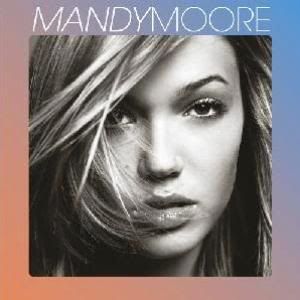
Soon after posting my list of underrated 2000's albums, I realized I'd accidentally left off an album as good--and as underappreciated--as most of those I'd included: Mandy Moore's self-titled third album. The reason for this is likely that I myself didn't hear it until five years after its release so, in consulting my year-end lists to put together the one below, it was nowhere in sight; I finally caught up with Moore's excellent 2001 disc in 2006 thanks to Teresa's enthusiasm for it.

It's an album that bravely defies what one would expect a Mandy Moore album (or an album by any turn-of-the-21st-Century American pop starlet) is supposed to sound like; those who, having never head this one, write Moore off as the less risky, blandly MOR alternative to edgier contemporaries Britney and Christina should certainly play catch-up. In terms of gossip column overexposure, sure, Mandy has never held a candle to them and never will, but the music on Mandy Moore ranges from smart-sensitive folk to Eastern-tinged pop to club-ready dance cuts--all of which she nails impeccably. Perhaps it's not surprising that the album's sales were disappointing (a decade later, it still hasn't gone Gold); while there's not a track in sight that constitutes filler, there's also nothing as tailor-made for Top 40 radio as "Candy." Moore was just 17 when the album was released--there's an ironically mature-sounding track titled "17" located about midway through the record--and much of her presumed fanbase at that point was likely younger yet. Those with less of an excuse for missing the boat are music critics, in theory, trained to recognize and reward artistic growth and ambition, both clearly on display on Mandy Moore. Plus, the songs are great--which always is, and should be, the bottom line.
Unknown Pleasures


With the first decade of the new millennium now in the rear view mirror, I think it's a good time to look back at the 2000's albums that were entirely slept-on, deeply underrated, or that, for whatever reason (the artist or group quickly disappeared from prominence, they released subsequent work that felt redundant or generally less interesting, they were part of a "sound" or "scene" that didn't have legs to it), people liked enough at the time and yet now no one really mentions them--or, as is often the case with the albums on my list below, some combination of those fates. My chief consideration in putting together this list from previous ones I've made year to year is whether the music still holds up or whether I find myself second-guessing my own enthusiasm of years past. I've tried to avoid albums from the the last couple years of the decade because it seems too soon to know both how they'll hold up and where critical and popular opinion will ultimately land. Without further introduction, here's my top ten-plus.

10.
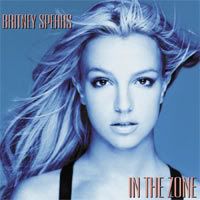
Blackout is a bona fide masterpiece and certainly Britney's high-water mark, but I've already written at length about it and, so far as I can discern, there does seem to be some general critical appreciation of Britney's "comeback" record and its dark, clubby sound. In the Zone, from its uber-cheap-looking cover shot to its classic-hit ("Toxic")/forgettable hit ("Me Against the Music")/filler rep, seems due for reconsideration. "Everytime" remains the finest ballad she's ever recorded; "(I Got That) Boom Boom," Britney's Ying Yang Twins-aided stab at crunk, while silly, isn't half-bad; and the R. Kelly-penned "Outrageous" lives up to its title. Yes, "Toxic" is the best track and by a fair margin, but it's a good point-of-entry, not a stopping point when looking at this transitional moment in Britney's career.
Key Songs:: "Toxic"; "Everytime"; "Brave New Girl"

09.

Nellie McKay (deservedly) got a ton of press for 2004's Get Away from Me. The problem is that the (fun but lazy) Eminem-meets-Doris Day angle most writers took covering Nellie's debut essentially pegged a prodigiously talented young artist, still very much in the process of finding her voice and style, as a one-trick pony. Pretty Little Head is a spottier affair than Get Away from Me, but it's also a more mature record, evincing nuanced growth in both McKay's songwriting and her politics. It's just as clever and as varied as its predecessor; unfortunately, outside of devoted fans, relatively few listeners bothered to keep in step with Nellie.
Key Songs: "Real Life"; "There You Are In Me"; "The Down Low"

08.
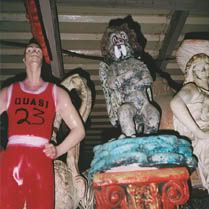
With all due respect to Introducing Cadallaca... and The Friends of Rachel Worth, this is the best non-S-K record featuring a Sleater-Kinney member. It's also hands-down the best thing Janet Weiss ever made with her ex-husband Sam Coomes. And yet, even among S-K diehards, who still talks about this album? 2001 wasn't that long ago and The Sword of God still sounds terrific.
Key Songs: "The Curse of Having It All"; "It's Raining"; "Fuck Hollywood"

07.
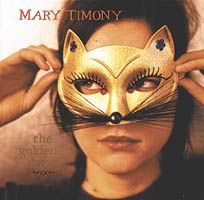
In a perfect world, Mary Timony's superb 2002 album would've come out five years later and capitalized on the good will generated by Joanna Newsom's much-acclaimed Ys, another album that dabbles affectionately in the archaic. Instead, the ex-Helium frontwoman was marginalized as a Renaissance fair geek. Ironically, she's much more interested in blurring the contemporary world with the ancient one than Newsom is on Ys; often, mundane 21st Century reality serves as a sort of jarring punchline for Timony's romantic fantasy leanings. The real story with the boy who turned into the titular "golden dove" and flew away, she tells us a line later: He "moved to California."
Key Songs: "Dr. Cat"; "Look a Ghost in the Eye"; "Musik and Charming Melodee"

06.
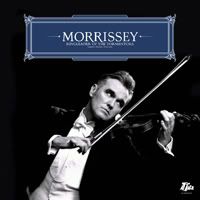
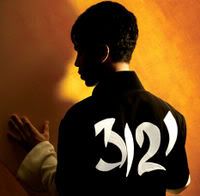
Legitimate comebacks that registered as mere blips on the popular/critical radar screen. Ringleader of the Tormentors might, start to finish, be the strongest record of Morrissey's post-Smiths career. 3121 isn't on par with Sign o' the Times or Purple Rain, but it's as good as Parade or Lovesexy, which is hardly faint praise.
Key Tracks (Ringleader of the Tormentors): "You Have Killed Me"; "I Just Want to See the Boy Happy"; "Life Is a Pigsty"
Key Tracks (3121): "Lolita"; "Black Sweat"; "The Word"

05.
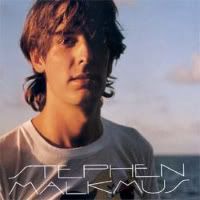
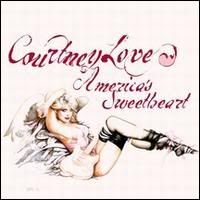
Stephen Malkmus and Courtney Love were among the most critically lionized artists of the '90's; their solo debuts provoked comparatively little interest, excepting scorn hissed in Courtney's direction. For my money, Malkmus' self-titled disc is the most through-inspired collection he's been wholly or partly responsible for since 1994's Crooked Rain Crooked Rain and it remains my favorite among his post-Pavement output. America's Sweetheart, meanwhile, was more or less critically reviled, but it's a much stronger set than Hole's mostly positively reviewed Celebrity Skin. Love actually picks up where that album's standout track, "Northern Star," leaves off--America's Sweetheart is all raw energy and open wounds. It's an updated distillation of the sound and fury that led 1994's Live Through This to top every critics' poll in sight; if it's sometimes hypnotic the same way the scene of a car crash is hypnotic, well, that's certainly more than can be said for most rock records.
Key Songs (Stephen Malkmus): "Jenny and the Ess-Dog"; "Church on White"; "Black Book"
Key Songs (America's Sweetheart): "Mono"; "All the Drugs"; "Hold on to Me"

04.
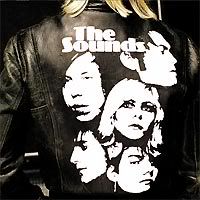
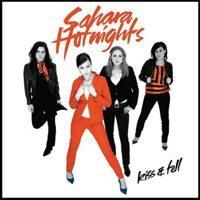
In a decade where "retro-" so often preceded descriptions of "rock" that it was eventually left off and assumed to be the case, I'll take these two over, say, Is This It and White Blood Cells. Those are both very good albums, to be sure, but they don't consistently make me grin the way the '80's-indebted Living in America and Kiss and Tell do. Only the New Pornographers did smart/sugary power-pop better in the 2000's--and their best work has no shortage of admirers.
Key Songs (Living in America): "Rock n' Roll"; "Like a Lady"; "Seven Days a Week"
Key Songs (Kiss and Tell): "Stay/Stay Away"; "Stupid Tricks"; "The Difference Between Love and Hell"

03.

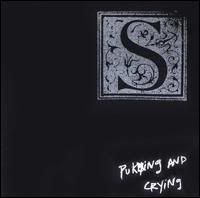
With Cat Power emerging this decade from relative obscurity into legitimate celebrity status, why not these three female singer-songwriters? Keren Ann enjoyed 15 minutes of minor notability on the heels of her excellent Not Going Anywhere, but at least on this continent, she's scarcely mentioned these days. Mirah remains a minor player within a certain segment of the indie rock establishment, due in part to her association with Super Cult Artist Phil Elvrum, but C'mon Miracle is among the most beautiful records of the decade and deserves substantially more credit. Meanwhile, S. (aka Jenn Ghetto) is probably the least-known of the three and 2004's perfectly titled Puking and Crying is at least as effective a soundtrack for depression (romantically-induced or otherwise) as Ms. Marshall's Moon Pix or Myra Lee.
Key Songs (Not Going Anywhere): "End of May"; "Right Now and Right Here"; "By the Cathedral"
Key Songs (C'mon Miracle): "Jerusalem"; "Look Up!"; "You've Gone Away Enough"
Key Songs (Puking and Crying): "Crushed"; "5 Dollars"; "100x"

02.

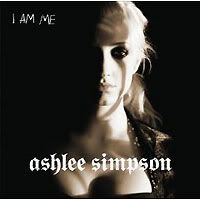
In the contest for most consistently underappreciated artist of the decade, Ashlee Simpson takes it by more than--sorry, terrible pun coming...--a nose. Her first two albums and, to a lesser extent her third, the decidedly spottier Bittersweet World, are upper-90th percentile all the way, which is much more than can be said for a large swath of '00's artists who came by praise and popular admiration a heck of a lot easier. Why? Because--and I can't stress this enough--Ashlee is much, much better at making appealing music than she is at being an appealing public personality. This is not the only trait Simpson shares with her artistic godmother, Courtney Love. On tracks like "Autobiography," "Love Me for Me," "I am Me," and "Coming Back for More," she summons a throaty, guttural growl worthy of Ms. Love or her late husband. When I caught her live shortly after her debut's release, she actually covered "Celebrity Skin." It was fun, but her highly specific vocal talents would've been much better suited to, say, "Rock Star" or "Doll Parts."
Key Songs (Autobiography): "Love Me for Me"; "Autobiography"; "La La"
Key Songs (I am Me): "Coming Back for More"; "I am Me"; "Boyfriend"

01.
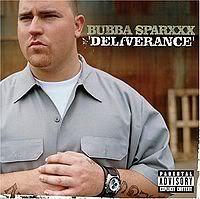
In a decade that began and ended with Eminem at or near the top of the charts and on the cover of innumerable magazines, it's really too bad that the other white rapper of note (no, I'm not talking about Mike Skinner) was relegated to the novelty/minor celebrity shelf. Bubba Sparxxx's first and third albums are completely likable collections with a handful of standout moments; his second is a masterpiece. In a cultural moment where the dots connecting rap to country suddenly appeared markedly less faint, Bubba is the only artist--with apologies to Kid Rock and Cowboy Troy--to really put it all together. It's also the absolute high-point of Timbaland's period of sonic dominance. The reviews were mostly positive (I'm proud to say that I gave it an 'A' back in '03), but the sales were disappointingly timid and Deliverance was sadly absent from most publications' best-of-the-2000's lists.
Key Songs: "Comin' Round"; "She Tried"; "Nowhere"; "Warrant"; "Deliverance"