My Own Private Apocalypse (Now)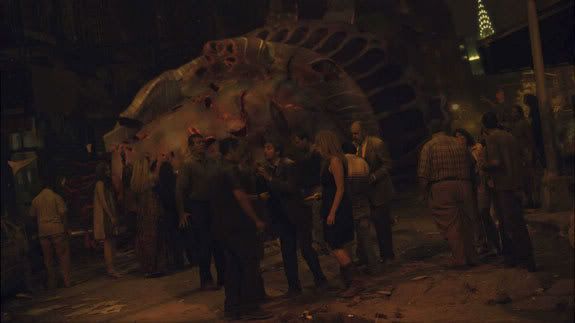 Cloverfield
 is almost inevitably a loaded deck. Unless you've remained entirely oblivious to the film's ingenious, if mostly irrelevant, viral marketing campaign (possible, though somewhat less so since you're reading this blog entry) and you've managed also to tune out the cultural impact of the digital revolution, this isn't, and never could be, your standard-fare blockbuster movie-movie. Hell, even then a truly clean slate would additionally require a failure on the viewer's part to connect the film's unambiguous post-9/11 dots: the shocking destruction of NYC landmarks; terrified, soot-covered masses scurrying for shelter inside bodegas and department stores, dialing local loved ones on their cells; news reports repeatedly analyzing on-site footage yet clearly unable to offer substantial answers.
This is New Media all the way--from the Web-based hype push to the faux-amateur delivered product--and it's as informed by September 11's events and their aftermath as by the genre cinema conventions it strategically borrows from and ultimately erupts. The obvious, seemingly irresistible comparison is to
The Blair Witch Project (see:
almost every fucking review published thus far), but that's too easy a reference-point and lends little insight into what this deviously brilliant flick is really up to. 1999's surprise horror hit never deviated from the first-person, pseudo-doc POV of its doomed trio. In
Cloverfield, key fragments of information are provided via TV news reportage, a distinction well worth citing.
Rather, the film that struck me as closest in spirit to this one is much more recent than the pre-9/11
Blair Witch. I'm thinking of Brian De Palma's groundbreaking, unfairly maligned
Redacted (and of
The Host, Bong Joon-ho's South Korean political-critique-disguised-as-a-creature-feature). Like De Palma's film, last year's best, in my estimation,
Cloverfield is impossibly meta--its cast of hip, well-heeled young Manhattanites are as much pop-cultural ciphers as
Redacted's stock military grunts. Where De Palma drew on the Vietnam war movies (including his own
Casualties of Wars) that today's generation of soldiers knows by heart, producer J.J. Abrams, writer Drew Godard, and director Matt Reeves look to Andrew Bujalski and the "Mumblecore" movement's hip, urban twentysomethings--or, you know, maybe just across the bridge to Williamsburg. Or (again like De Palma) to any number of YouTube clips or Facebook and MySpace pages at a generation of spoiled, disaffected rich kids with more high-end electronic gadgets than common sense.
Both films are acutely aware of the challenge facing movies, as well as every other traditional platform of entertainment and information: to hurry and catch up with the Internet, a medium that's increasingly rendering Hollywood's star system and the implicit cultural hierarchy it represents irrelevant. Neither film features an actor you've heard of, and the fact that their no-name casts are, at best, merely passable and, at worst, sort of shitty matters about as much as how "good" or "bad" the guy or gal was in the last home-made YouTube clip you watched.
Abrams and De Palma haven't failed to notice either the current ubiquity of all manner of recording devices; when a group of stunned New Yorkers pause to snap camera phone pictures of the Statue of Liberty's detached head just after it's crashed down in the middle of the street, the scene plays like an eerie, cracked-mirror reflection of right here and now. Meanwhile, in
Redacted, we're forced to piece together a skewed mosaic of the Iraq War as captured and deconstructed on personal digi-cams, surveillance video, documentary footage, blogs, American and Middle Eastern news outlets, and--right--YouTube.
Which leads us, in a roundabout fashion, to
Cloverfield's most problematic conceit: that some guy would maintain taping throughout everything that's going on around (and often right in front of) him. Since the film's claim to novelty lies in its you-are-there approach, its impact depends largely on our ability to make the leap of faith required to buy that "Hud" (our steadfast guide) wouldn't, at some point, toss the camera and just say to hell with it (not to mention that him and his friends wouldn't up and hightail it out of the city as fast as, and by any means, possible).
I can think of a few valid-ish explanations for this. The first is simply that in a city the size of New York there would presumably be at least one idiot/crack-journalist-at-heart who really would try to record the moment-to-moment developments of such an event. Another, suggested by Hud himself, is that the camera has become for him a security blanket of sorts, that witnessing the night's terrors through its lens somehow makes them feel less real or immediate or threatening (hmm, kinda like how watching the destruction of New York City, as projected on a theatre screen, feels infinitely safer than the present-tense reality that, hey, New York
was recently attacked, mysteriously and quite suddenly...)
Subsequently, perhaps the best excuse for
Cloverfield's found-footage gimmick is that many people did, in fact, impulsively record the Twin Towers collapsing now six-plus years ago. Which is to say, this is neither escapist entertainment (ala, say,
Independence Day, wherein alien invaders obliterated the Empire State Building) nor verite catharsis (ala Paul Greengrass' masterful
United 93). It's something else, something new and strange and, at the same time (and above all), disturbingly familiar. Of course, the message is the medium, but it's also the mountains of hype, both justified and purposefully misleading, and the painful historical baggage inextricably tied to this film's sounds and images.
The weird beauty of
Cloverfield is that it is what it is--a potent, poisonous stew made up of myriad ingredients added by both its creators and its audience, yet finally
suis generis (rather like New York itself). If the film's ending(s) feel too ironic (the romantically linked main pair are killed not by the rampaging monster but by military bombs, then the source recording ends with a happy, earlier scene at Coney Island), well, so is its existence--a 73-minute filmic extension of our conflicted collective desire to relive our worst nightmare. It's not just art imitating life, but shrewdly criticizing it in the process. No doubt it will be a huge hit.
And I don't just mean in the U.S. of A. Assuming this movie screens in the areas of the world where America and what it represents are least popular, it should do gangbusters, with the creature implicitly recast as the story's hero. It doesn't take a theatre full of "evildoers" either to fail in recognizing any good reason to actively root for
Cloverfield's white-collar VP protag, Rob, and his WASPy cohorts; the only one I can think of (aside from that they're, you know, human beings) is that, for better or worse, they're audience surrogates, but that's instinctive rather than logical or even empathetic. Where
Redacted (myopically accused of anti-Americanism) shows us Americans abroad at their extreme-worst, raping and murdering and waxing xenophobic like it's second-nature,
Cloverfield centers on Americans at home at their quotidian-worst, merely privileged and solipsistic and willfully sequestered in Very Nice Spaces.
"The government's about to lay the hammer down on it," says an army officer. "Midtown?" asks our stunned would-be hero. "No," the officer responds, "Manhattan." It's a telling moment of realization for Rob and for us: Really? The U.S. government effectively giving up on its single most celebrated stretch of real estate? Substitute "Manhattan" with, say, "New Orleans" in that equation and it really hits home--not to mention Hiroshima, Cambodia, and Baghdad.