Done Gone Global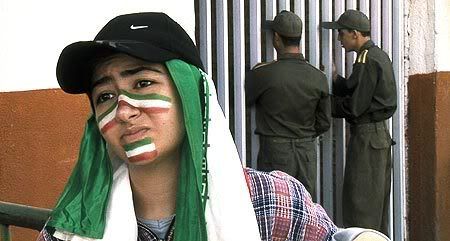
Brief notes on five good movies--three from Japan, one from Iran, and one from Canada.
Offside Kiarostami disciple Jafar Panahi's reputation as contemporary Iranian cinema's second-finest filmmaker (after his mentor) has been effectively solidified; this one splendidly reaffirms what we already knew. Shooting in and around a World Cup qualifying soccer match between Iran and Bahrain (fan chants include "Iran...winner! Bahrain...loser!" and "What does Iran do? Iran riddles you with goals!"), Panahi's latest is a comic companion piece to 2000's masterful
The Circle. Both films focus on the treatment of women in the Islamic Republic, but where the earlier work illuminated some of the harsher fates endured by women under Iran's patriarchal laws,
Offside--no less perceptively--takes a more light-hearted route.
The new film has been criticized by some for supposedly depicting the soldiers assigned to monitor women caught attempting to sneak into the soccer game in drag (females aren't allowed to attend sporting events in Iran--unless they're foreigners who don't speak Farsi, and thus can't understand Iranian men when they're swearing) in a sympathetic light. I'd argue that this stroke of inclusive humanism is key among
Offside's strengths. Why demonize a few farm boys serving their mandatory military service, visibly in over their heads in urban Tehran? Like the majority of American soldiers currently deployed in Iraq (many of them lured into the armed services as a means to afford a college education), they shouldn't be held accountable by the dubious policies and decisions of their nation's leaders. This would certainly make for a provocative double feature paired with Brian De Palma's devastating
Redacted. Because Panahi and De Palma's films offer very different looks at military (ir)responsibility--not because Iran's next on the Bush administration checklist.
Tekkonkinkreet I'm sure I'm not the first critic to preface a review of this movie by confessing a very limited familiarity with Japanese animation. A handful of Miyazaki, a couple Satoshi Kon stunners,
Metropolis,
Akira, and
Ghost in the Shell are collectively about as deep as my anime viewing experience runs. Michael Arias' debut feature, combined with Kon's
Paprika and
Tokyo Godfathers, leave me wondering exactly how much else I've missed.
Tekkonkinkreet, which seamlessly marries traditional animation with CGI to consistently eye-popping effect, is as visually inspired as Kon or Miyazaki, though Arias lacks, for now, their knack for narrative momentum. Yet even when this one gets a touch too convoluted, the images on-screen remain hypnotic. In fact, just as the plot begins to sag under the weight of too much forced philosophy, Arias launches his visual palette into another stratosphere. A must-see for cinephiles who still think the conversation on worthwhile anime begins and ends with Miyazaki.
Nightmare Detective The three Shinya Tsukamoto films I've seen vary drastically in terms of quality (if not aesthetic): one's a near-masterpiece (2004's
Vital), one I only made it halfway through without falling asleep (2002's muddled
Snake of June), and then one that might've been a full-on masterpiece, ultimately doesn't come close, but that I didn't nod off during either. The latter is Tsukamoto's latest offering, in which he perfects the cold, steely visual scheme and off-kilter
mise-en-scene that contributed to
Vital's atmospheric appeal. The film starts off brilliantly, with an ingeniously orchestrated horror set-piece, an intriguing central concept (suicidal Tokyo residents fighting for their lives against some murderous, invisible force), and terrific characterizations by Ryuhei Matsuda and J-Pop star Hitomi. It eventually runs off the rails, though, the same way plenty of better and worse horror movies, Japanese or otherwise, have before it--by, finally, being too simple (e.g., spoiling the mood and the mystery by revealing too much too soon) and too complicated (e.g., by overexplaining the conceit and inserting too many pointless twists). Tsukamoto does deserve bonus points for the ballsy/self-reflexive gesture of casting himself as the villain revealed in the film's otherwise regrettable final act, but it's too little too late in a pretty good movie that could have been pretty great.
Retribution Kiyoshi Kurosawa's latest suffers from many of the same revelation/resolution issues that plague
Nightmare Detective, yet it feels more even and balanced thanks to the plaintive, meditative tone that Kurosawa maintains from start to finish--even as his horror show takes a few dubious detours of his own. It isn't better, or any less chilly, than the Tsukamoto; its peaks aren't as high, it's valleys aren't as low. Like K. Kurosawa's previous effort, the superior
Loft, it's a ghost story where, so to speak, the storm is a slow-burn established through the uneasy collision of fronts existential and fatalistic. It's a dynamic as central to Kurosawa's aesthetic as deterministic pessimism is to the work of David Fincher, for better or worse, Kurosawa's closest kindred spirit in Hollywood. Both typically prefer drab, confining spaces, and lead performances that are, at once, melancholic and muscular. Fincher emphasizes humanity's worst impulses, while Kurosawa opts for the paranormal, a distinction that arguably speaks volumes about the East-West cultural divide.
Let's All Hate Toronto Prior to noticing this DVD on the video store shelf, I had almost no idea that the rest of Canada was so down on its largest metropolis. My only hint was hearing Teresa casually opine that "Toronto sucks" whenever the subject came up, despite the fact that she's never set foot in a province east of British Columbia. Evidently, she's not alone in that sentiment. Montreal native Albert Nerenberg and Robert "Mr. Toronto" Spence's comic doc traces this seemingly peculiar trend from the Maritimes to Quebec to Alberta to Vancouver, the latter of which they identify as the most anti-Toronto city in the federation (save for, perhaps, Toronto itself). The film missteps with some sub-Michael Moore gags along the way, but ultimately presents a coherent snapshot of Canada's problematic relationship with its self-designated "center of the universe," offers thoughtful explanations, debunks (positive and negative) stereotypes, and finally concludes that Toronto sucks "only a little." Teresa remains unsold. I think Toronto seems nice, but what do I know--I'm an American transplant, and one of the major gripes voiced against Ontario's capital is that it's essentially an American city located inside the Canadian border. Speaking of which, the U.S. of A. has its own venomous/grudgingly recognitial relationship with a certain T.O.: ours plays football in Dallas.